To
skip to main content: Press Enter
SULFUR METABOLISM IN BACTERIA

Conference on molecular dynamics, 1884
Lord KELVIN
Sulfur metabolism in Bacteria, with emphasis on Escherichia coli and Bacillus subtilis
Agnieszka Sekowska & Antoine Danchin
An earlier presentation of the views proposed here has been published in year 2000 in Hong Kong and should be used as a reference for work published previous to that year.
Sulfur is an ubiquitous element of the Earth crust where it is mostly present as sulfate salts. Far from dioxygen it may be present in reduced metal-binding forms, such a pyrite (fool's gold) in rocks. It is an essential component of life. Most recent scenarios depicting the Origin of Life place sulfur at a crucial position. In biological processes the role of sulfur is limited to a series of highly specific objects, in particular involved in electron transfers. The presence of gaseous dioxygen has further enhanced the versatility of the processes where this atom is involved. This is probably due to the fact that it is a very reactive atom, and that many chemical reactions involving sulfur consume a large quantity of energy. It is therefore of prime importance to understand sulfur metabolism in model organisms and then extend the corresponding knowledge to other ecological niches. The various inorganic states of sulfur have been well studied, and the corresponding knowledge is fundamental for understanding mineralogy and soil biology (for a review see Ehrlich, 1996). In contrast, the organic cycle of sulfur is much less well known, and metabolism of sulfur, in spite of its central importance (but perhaps because of its difficult chemistry), has been relatively neglected by investigators. For this reason, many steps in sulfur metabolism have been mistakenly ascribed wrong functions that still plague genome annotations.
In 2010 was published a surprizing article that proposed arsenic as replacing phosphorus in the backbone of nucleic acids. A straightforward analysis of the chemical situation, based on reasoning that is useful to understand the core or sulfur metabolism, would have told scientists and educated persons that this is certainly not possible. The arsenic nightmare tells us that we should be very careful to base our knowledge of the previous knowledge accumulated over the years by scientists all over the world, and not to reinvent a crippled wheel...
A. General sulfur metabolism
Three well differentiated processes must be separated in the general metabolism of sulfur: synthesis of the sulfur-containing amino acids (cysteine and methionine), together with that of the sulfur-containing coenzymes or prosthetic groups; catabolism and equilibration of the pool of sulfur containing molecules; and methionine recycling (a topic in itself, be it only because of the role of methionine as the first residue of all proteins). Several databases devoted to metabolism allow one to retrieve extant data relevant to sulfur metabolism such as: the Kyoto Encyclopedia of Genes and Genomes (KEGG), the WIT (What is there?) database of the US Department of Energy at Argonne, BRENDA and the database of SRI, EcoCyc. Specialized microbial genome databases, Colibri and SubtiList provided direct information about the genes and genomes of the model organisms Escherichia coli and Bacillus subtilis. Other databases maintained within the GenoChore suite allowed one to have access to further information on a variety of bacteria.
Anabolism
Sulfur distribution On average, the sulfur concentration at the surface of the Earth is estimated to be of the order of 520 ppm. It varies in rocks between 270 and 2400 ppm. In fresh water, it is 3.7 ppm on average. In sea water, it reaches 905 ppm. In temperate regions, it varies between 100 and 1500 ppm in soil (Ehrlich, 1996). However, its concentration in plants is usually low. This element is present essentially in the form of the amino acids cysteine and methionine, their oxidation products, as well as molecules of reserve or osmoprotectants, such as S-methylmethionine (Kocsis et al., 1998) or various types of sulfonates (Cook & Denger, 2001; Kertesz & Wietek, 2001). It is also found in many derivatives of secondary metabolism (in particular in garlic-related plants, Atmaca, 2004), where these sulfur-containing metabolites play a very efficient antimicrobial role), and as sulfated carbohydrates or aminoglycosides (Chai et al. 2004; Nazarenko et al., 2003).Oxido-reduction and assimilation of sulfur In the presence of oxygen, sulfur metabolism is particularly energy costly. As sulfate, it must first permeate the cell, usually against the intracellular electric potential which is usually strongly negative (-70 mV), then change from a highly oxidized state to a reduced state. This requires a significant consumption of energy, as well as the maintenance of a very low oxido-reduction potential, a proces that seems difficult to achieve with the simultaneous presence of oxygen molecules (Table 1- translated from A. Sekowska PhD thesis).
Table 1. Electron transfers in the absence of photosynthesis
|
Reducing agent
|
Redox couplea
|
E0' [mV]b
|
DG0' [kJ*mol-1]c
|
Organisms
|
|
Carbon monoxide |
CO2/CO |
-540
|
-261
|
'Carboxidobacteria' e.g. Pseudomonas |
|
Hydrogen |
2 H+/H2 |
-410
|
-237
|
'Knallgas' bacteria |
|
Sulfide |
S0/HS- |
-260
|
-207
|
Thiobacillus, Beggiatoa, Wolinella succinogenes |
|
HSO3-/HS- |
-110
|
-536
|
Thiobacillus, Sulfolobus |
|
|
Sulfur |
HSO3-/S0 |
-45
|
-332
|
Thiobacillus |
|
Sulfite |
SO42-/HSO3- |
-520
|
-258
|
Thiobacillus |
|
APS/HSO3- |
-60
|
-227
|
Thiobacillus |
|
|
Ammonium |
NO2-/NH3 |
+340
|
-276
|
Nitrosomonas |
|
Nitrite |
NO3-/NO2- |
+430
|
-75
|
Nitrobacter |
|
Fe2+(pH 2) |
Fe3+/Fe2+ |
+770
|
-32
|
Thiobacillus ferrooxidans, Sulfolobus |
|
Oxygen |
O2/H2O |
+816
|
Cyanobacteria |
a. The reaction procedes from the reduced state to the oxidized state, but convention asks that it is represented in the order: product/substrate.
b. Redox reactions are reactions where a substrate is reduced (electron acceptor) and another one is oxidized (electron donor). DE is the difference potentiel between the end and the start of the reaction. DE0' is the redox potentiel difference (that can for example generate a protonmotrice force) of a biochemical reaction in standard conditions: 298 K (25°C), pH 7.0 and where the concentration of each reagent is 1 mol/liter except for water (normal concentration 55.55 mol/liter) and gases (pressure of 101.3 kPa = 1 atm). The reaction occurs spontaneously only when the value of DE is negative, i.e. when the potential evolves towards more negative values. The redox potential is usually represented with the negative values above, and the spontaneous reactions procede from top to bottom.
c. For each component of the system one attributes a quantity of free energy 'G', composed of an enthalpy 'H' (internal energy plus pressure multiplied by the volume) and of an entropy 'S' (measuring the degrees of freedom of the system, in terms of positions and energy levels available to its different components). In the cases where the absolute values are not large, the changes in G (DG) are decisive for the chemical reaction. The reaction occurs spontaneously only when the value of DG is negative. DG0' is the DG of the biochemical reaction in standard conditions as defined above.
Cell compartmentalization is therefore a prerequisite to sulfur assimilation and this is reflected in the organization of sulfur metabolism genes into clusters in the chromosome (Rocha et al., 2000).
In Escherichia coli, where the pathway has been best established, the genes involved in these reduction steps are organized as several operons (Kredich, 1996). Operon cysDNC codes for subunit 2 of sulfate adenylyltransferase, subunit 1 of ATP sulfurylase (ATP:sulfate adenylyltransferase) and adenylylsulfate kinase. Genes cysZ and cysK may not be co-transcribed, although they are neighbours in the chromosome. CysZ is probably a membrane protein, but its function is unknown. CysK is O-acetylserine sulfhydrylase, phylogenetically related to tryptophane synthase (Lévy & Danchin, 1988, see also minerals and the origin of life). E. coli ATP sulfurylase forms a tight, catalytically-coupled complex with the last enzyme in the cysteine biosynthetic pathway, O-acetylserine sulfhydrylase (Wei et al., 2002). Operon cysPUWAM codes for a thiosulfate (and sulfate) periplasmic binding protein, an ABC-type membrane permease, and a minor O-acetylserine sulfhydrylase, specific for thiosulfate. Finally cysE codes for serine O-acetyl-transferase. It may lie in operon with genes yibN, grxC, secB and gpsA (coding respectively for: a rhodanese-related sulfurtransferase, a glutaredoxin: glutathione-dependent redoxin, an element of the protein secretion machinery, and most probably a glycerol-phosphate dehydrogenase, possibly used in phospholipids biosynthesis). Gene cysE is the start point of cysteine biosynthesis, probably derived from an ancestral serine metabolism (Wächtershäuser, 1988; Danchin, 1989).
Sulfate is first transported into the cell, as we shall detail later on, then it is assimilated in the form of adenosine phosphosulfate (APS), by an ATP sulfurylase (coded by genes cysDandcysN). This reaction, which yields APS and pyrophosphate from ATP and sulfate, is thermodynamically strongly shifted towards ATP synthesis (and, therefore, not towards sulfate incorporation), because the DG0' of hydrolysis of the APS phosphate-sulfate bond (-19 kcal/mol) is considerably higher than that of hydrolysis of the a,b bond of ATP (-10,7 kcal/mol, Liu, 1998). It is therefore necessary that an important activity keeps efficiently the pyrophosphate concentration to a low level (through hydrolysis into inorganic phosphate) to pull the reaction towards the anabolic direction. This is assumed by one or several pyrophosphatases, whose essential role is to pull the pyrophosphate-producing macromolecular biosynthesis reactions towards the direction of anabolism (figure 1). However, as witnessed by the rather high intracellular pyrophosphate concentration in E. coli, it seems that this reaction is far from equilibrium. It cannot therefore be sufficient to pull the reaction toward synthesis of APS (Liu, 1998). This is why the synthesis of this latter molecule is also linked with hydrolysis of the b,g bond of GTP, which favors the reaction of sulfate incorporation (105-fold with respect to the reaction in absence of GTP). The coupling of the synthesis of APS with GTP hydrolysis displaces the equilibrium of the reaction towards sulfate assimilation (DG0' = -6,8 kcal/mol) (Liu, 1998). However, this implies an extremely high cost of incorporation of sulfur in sulfur-containing molecules. This drives a strong selection pressure for the recovery of molecules which contain sulfur in reduced state, a fact that has to be taken into consideration when analyzing sulfur metabolism.
A further energy-consuming step sometimes shifts further the reactions towards sulfur assimilation. In E. coli APS is the substrate of a kinase (CysC), in a reaction that utilises a second ATP molecule to phosphorylate the 3’OH positionofAPS, which is meatbolized into 3’phosphoadenosine phosphosulfate (PAPS). The raison d'être of this reaction, which from ATP produces PAPS and ADP, seems to be a supplementary means to pull the reaction towards the anabolic direction. The sulfate activation pathway is essential for the assimilation of sulfate and, in many bacteria, is comprised of three reactions: the synthesis of APS (adenosine 5' phosphosulfate), the hydrolysis of GTP, and the 3' phosphorylation of APS to produce PAPS, whose sulfuryl group is reduced or transferred to other metabolites. The entire sulfate activation pathway is organized into a single complex in Mycobacterium tuberculosis (Sun et al., 2004). The catalytic efficiency of PAPS synthesis is considerably higher than that of APS synthesis, and PAPS is formed extremely fast.
ATP4- + SO42- <–> APS2- + P2O74-
GTP4- + H2O <–> GDP3- +HPO42- + H+
ATP4- + APS2- <–> ADP3- + PAPS4- + H+
and a further reaction
P2O74- + H2O <–> 2 HPO42-
drives the overall pathway towards PAPS synthesis.
In fact, not only the 3' phosphate of PAPS has no specific function, but it must be metabolized into a by-product of the reaction, PAP (3'-5'ADP), with no known function in metabolism (figure 1). In many bacteria (but we did not find the corresponding enzymes in E. coli or B. subtilis), the plants and the animals, PAPS is the necessary precursor for the sulfatation of various molecules (carbohydrates in particular) by sulfotransferases (Kusche, 1991; Suiko, 1992; Varin, 1992). In M. tuberculosis PAPS is involved in sulfatation of a lipid important for protecting the baceria against the host defenses, and hence releavant to pathogenicity (Mougous et al. 2004).
In the sulfur assimilation pathway, PAPS is reduced into SO32-, yielding adenosine 3’-5’ diphosphate (PAP) as a by-product. It will therefore be interesting to investigate the fate of PAP after sulfate reduction. This is all the more important because this same molecule is produced in another reaction starting from coenzymeA, the transfer of the 4-phosphopantetheine group on the acyl carrier protein (ACP) of the complex synthesizing fatty acids (see Sekowska et al, 2000 and below). Finally, synthesis of secondary metabolites such as peptide antibiotics, surfactin of polyketides also require the transfer of 4-phosphopantetheine from coenzymeA, producing PAP as a by-product (Reuter, 1999). This implies the existence of a 3’-5’ diphosphoadenosine phosphatase, yielding 5'-AMP and inorganic phosphate. Protein CysQ (Swiss-Prot: P22255) may be the missing phosphatase, although we did not find explicit experimental data proving this contention. York, 1995, CysQ is similar to a plant adenosine diphosphate phosphatase Gil-Mascarell, 1999 involved in the reduction of sulfite to H2S (Swiss-Prot: Q42546). This enzyme (HAL2=MET22 Glaser, 1993) is probably also present in yeast, where its inactivation lead to methionine auxotrophy. The plant enzyme (encoded by the HAL2-like gene RHL Peng, 1995) is sensitive to the presence of sodium ions and its activity is, for some unknown reason, associated with the resistance to osmotic stress. Because of its role, one may wonder whether PAP phosphatase is not present in the cell in the neighborhood of adenylate kinase, which scavenges AMP. One should finally ask whether PAP does not play a regulatory role in a cell process controlling the entry of oxidized sulfur into the cell, eventually coupling this metabolism to that of lipids. Let us note in this respect that this molecule is very similar to cyclic AMP, a well-known regulator of gene expression (Ullmann & Danchin, 1983).
The enzyme involved in the reduction of sulfate, phosphoadenosine phosphosulfate reductase (EC 1.8.99.4) (thioredoxin-dependent PAPS reductase) (PADOPS reductase) is coded by gene cysH.
5'-phosphoadenosine-3'-phosphosulfate + thioredoxin reduced
<–>
phosphoadenosine phosphate + thioredoxin oxidized + sulfite
The sulfite ion is reduced by NADPH-sulfite reductase (EC 1.8.1.2), an enzyme comprising two subunits, coded by operon cysJIH. Subunit a (coded by gene cysJ) involves FAD, whereas subunit b (coded by gene cysI) involves an iron-sulfur center and a siroheme prosthetic group (analogous to siroheme-dependent nitrite reductases). This implies a strong link between iron and sulfur metabolims, as well as with heme or vitamin B12 biosynthesis. The sulfhydryl ion, HS-, is quite reactive and toxic to the cell if it is concentrated. The synthesis of siroheme is catalysed by a SAM-dependent uroporphyrinogene III methylase (EC 2.1.1.107), encoded by gene cysG that forms an operon with genes nirBDC coding for the nitrite reductase and possibly with genes yhfLMNOPQR, coding for the metabolism of fructoselysine. Siroheme is present in two enzymes, sulfite reductase and nitrite reductase. In addition, it is a precursor of the B12 coenzyme (that neither E. coli K12 nor B. subtilis 168 can entirely synthesize).
Remarkably, in M. tuberculosis (and B. subtilis as well) it has been found that APS can be used as the ultimate step in sulfite synthesis. However, it is not cleaer that this is the situation in vivo. This does not seem likely as PAPS would be only used for sulfatation that produce sulfolipids, putative virulence factors, in M. tuberculosis. The cysDNC operon codes for the multifunctional enzyme complex that exhibits the three linked catalytic activities that constitute the sulfate activation pathway. In B. subtilis, the cysH gene codes for a PAPS reductase, that has a significant APS reductase activity (Berndt et al., 2004), as in M. tuberculosis (Williams et al., 2002).
Many kinds of intermediary sulfur oxidation states exist: sulfite, thiosulfate, etc. Complex oxido-reduction systems permit to reach the ultimate reduction state, that of hydrogen sulfide, H2S. These systems are often poorly known. However, one knows that, for example, thiosulfate can be an excellent sulfur source in E. coli Sirko, 1995). With respect to organic sulfur forms, things are also poorly known. The situation in Bacillus subtilis is being unravelled but not yet completely understood. It is significantly different from its counterpart in E. coli.
Biosynthesis of cysteine The reaction catalyzed by CysE (serine transacetylase, EC 3.1.3.7) condenses an acetyl group from acetyl CoA on the hydroxyl group of serine, forming O-acetylserine. Sulfur, reduced as H2S, reacts with O-acetylserine in E. coli to give cysteine. Genes cysK and cysM code for O-acetylserine (thiol)-lyase-A and -B, or O-acetylserine sulfhydrylase A and B (EC 4.2.99.8) Lévy, 1988; Kredich, 1996). Serine transacetylase and O-acetylserine sulfhydrylase A form an enzyme complex, cysteine synthase. In contrast, O-acetylserine sulfhydrylase B does not belong to an identified enzyme complex. Both O-acetylserine sulfhydrylases use sulfide as a nucleophile, but O-acetylserine sulfhydrylase B possesses also a characteristic feature, the ability to use thiosulfate in the place of H2S, leading to the production of S-sulfocysteine. The conversion of S-sulfocysteine into cysteine has not been demonstrated in E. coli, and this casts doubt on the physiological importance of this activity. However, as we shall see later, there exist numerous sulfonatases that may act on this molecule, yielding cysteine and a sulfate ion, which would thus enter the normal pathway.It is useful to understand the synthesis of O-acetylserine and its regulation, because the intermediary metabolites are very often regulators of gene expression, as we shall see below for the role of N-acetylserine in E. coli. N-acetylserine (that derives from O-acetylserine) is probably an inducer of the cys regulon. This molecule is formed by spontaneous cyclisation of O-acetylserine. The conversion of O-acetylserine into N-acetylserine is produced at the rate of 1% per minute at pH 7.6, and almost ten times faster at pH 8.6. The reverse reaction does not happen, which means that O-acetylserine but not N-acetylserine can serve as a sulfur acceptor. In contrast, N-acetylserine is approximatively 15-fold more efficient than O-acetylserine in its inducer action (Kredich, 1992).
Synthesis of methionine Methionine synthesis is linked to cysteine synthesis through metabolic pathways that differ according to the organisms. There often exist several different pathways in the same organism. In E. coli, the biosynthetic pathway is the following (figure 2) Greene, 1996).Biosynthesis of methionine originates from the homoserine pathway (which branches to lysine – via diaminopimelate, an essential component of mureine – to threonine, and to isoleucine), starting from the synthesis of an activated derivative, O-succinylhomoserine. This activated homoserine condenses directly with cysteine, giving cystathionine. A S-lyase, belonging to a large family of enzymes that allow the cleavage of molecules of the X-CH2-S-CH2-Y, or X-CH2-S-S-CH2-Z type, from either side of the sulfur atom, liberates homocysteine and serine (which is cleaved into pyruvate and ammonium). Homocysteine is the precursor of methionine, whose methyl group comes from the one-carbon metabolism (figure 3). In E. coli, two enzymes which catalyze this methylation exist. One of them, the product of the metH gene (EC 2.1.1.13), utilises vitamin B12 as a cofactor, and the methyl group can be taken from 5-methyltetrahydrofolate or from its polyglutamyl derivative. The second one, the product of gene metE (EC 2.1.1.14), which is not coenzyme B12-dependent, catalyses the methylation with 5-methyltetrahydropteroyltri-L-glutamate as the methyl groupe donor Kung, 1972). In both cases the original carbon derives from serine.
One can wonder why there exist two different genes for this metabolic step. In fact, one of them utilises coenzyme B12 (that necessitates at least 26 steps for its synthesis, starting from uroporphyrinogene III (Michal, 1999) and consumes seven molecules of S-adenosylmethionine. E. coli does not synthesize coenzyme B12, but possesses a transport system (btuBCDE and btuR) highly specific and efficient for this coenzyme (Colibri). The reaction catalyzed by protein MetH with coenzyme B12 is more than one hundred-fold faster than that catalyzed by the B12-independent enzyme, MetE (EC 2.1.1.13) Greene, 1996). It follows that the availability in methyl groups (we shall see below how important they are), via methionine, is provided much more easily in the presence than in the absence of coenzyme B12.
Methionine synthesis genes, metA (homoserine O-succinyltransferase, EC 2.3.1.46), metB (cystathionine g-synthase EC 4.2.99.9), metC (cystathionine b-lyase, EC 4.4.1.8), metE (5-methyltetrahydropteroyltriglutamate-homocysteine methyltransferase, EC 2.1.1.14) and metF (5,10 methylenetetrahydrofolate reductase, EC 1.7.99.5) are more or less spread out in the chromosome. The operon metB comprizes another gene, metL, that codes for a bifunctional enzyme AKII-HDHII (aspartokinase II/homoserine hydrogenase II, EC 2.7.2.4 and EC 1.1.1.3), belonging to the part of the aspartate derived pathway which branches out to threonine, lysine and methionine synthesis Saint-Girons, 1988).
There exists finally a pathway for recycling of methyl groups, recently found, that utilises S-methylmethionine as a methyl donor. This molecule, synthesized by plants, is scavenged by the product of gene mmuM (formerly yagD, with a strong similarity with metH), S-methylmethionine:homocysteine methyltransferase, which transfers methyl group directy onto homocysteine to give methionine (Thanbichler, 1999, Table 2).
Transport of sulfur-containing molecules and sulfur scavenging
Amino-acid and peptide permeases
There certainly exist permeases for the sulfur-containing amino-acid: cysteine, its oxidation product cystine, homocysteine and homocystine, and methionine. They have however rarely been characterised without ambiguity. One may think that transport of methionine is carried out by branched-chain amino-acid permeases (liv in E. coli, azlCD and braB brnQ in B. subtilis), but one must wonder about the possible existence of specific permeases Greene, 1996). Indeed, there exists a permease for S-methylmethionine, encoded by gene mmuP (formerly yfkD), in an operon with gene mmuM (Table 2). In the case of B. subtilis methionine is transported by several permeases but the most efficient one is the metNPQ (yusCBA) operon that encodes an ABC permease transporting methionine sulfoxide, D- and L-methionine (Hullo et al., 2004).
Independently from their transport, the presence of reduced amino acids (cysteine and homocysteine) must pose a problem to the cell, since they are very reactive (reducers), and this must be taken into account when one explores the way in which they permeate the cell. In order to understand their possible effects, it is useful to remark that the distribution of cysteine-containing proteins is not random in general. In the cytoplasm, one often finds proteins containing a metal, and in particular the diverse types of iron-sulfur centers (often with clustered cysteine residues), isolated cysteines (often involved in the catalytic mechanism), and cysteines burried in the hydrophobic regions of proteins. In contrast, the periplasm possesses a strongly oxidizing character (in the presence of oxygen), necessary for the formation of tertiary and quaternary structures of all kinds of proteins through disulfide bridges. The intrusion of strongly reducing molecules may therefore have a deleterious role.
Probably, the problem of cysteine toxicity in its reduced form does not occur frequently, because it is not present in nature in significant amount, but is saved perhaps in environments devoid of oxygen. Cystine is likely to be more common, and it is probable that there exists a system permetting its transport, and its rapid metabolism (a b-lyase for example). This seems more necessary because cystine is structurally similar to diaminopimelic acid (figure 4), an essential component of many eubacteria cell wall, E. coli in particular. As in the case of every molecular mimic, it may therefore take the corresponding place, and interfere with the synthesis of mureine, leading to cell lysis Richaud, 1993).
There exist many proteases and peptidases in bacteria Miller, 1996), and the externl medium (the gut in particular) such as those faced by E. coli often contain peptides. Several transport systems allow their salvage (Dpp, Tpp and Opp Oliver, 1996). A specially important case, despite the fact that it has hardly been studied, is that of peptides from the amino-terminal ends of proteins. They often carry a N-formyl-methionine group, specific for translation initiation. It has indeed been discovered that in the eucaryote hosts that live in the presence of commensal or pathogenic bacteria, there exist several recognition and transport systems for these peptides Schiffmann, 1975; Prossnitz, 1999). This indicates that these molecules are produced and secreted in significant quantity. It seems likely that bacteria also possess transport systems allowing their salvage. Nobody knows, at this time, if permeases Dpp, Tpp or Opp are adapted to this transport, or if there exist other similar permeases. In the same way, the pathways for the degradation of these peptides allowing methionine salvage, have not been studied. This would be more interesting because these molecules can easily be visualized as participating in a new process allowing "quorum sensing".
Sulfate and thiosulfate are transported in E. coli by proteins coded by operon cysPUWAM and by an isolated gene, spb. These transport systems are composed of a single permease (coded by genes cysUWA, the products of which are associated with the membrane) and of two periplasmic binding proteins specific for these two anions: TSBP (thiosulfate-binding protein), coded by gene cysP, and SPB (sulfate-binding protein), coded by gene spb Sirko, 1995). Another protein, CysZ, is also necessary for transporting sulfate, but its exact function is not known. The two periplasmic proteins, TSBP and SBP, share their specificity for the same substrates. This accounts for the fact that the simple mutant is always capable of transporting either anion (less efficiently, which slows down its growth as compared to the wild type). The double mutant only is incapable of transporting both anions.
Many molecules comprising sulfur in an oxidized state (sulfinates: -C-SO2; sulfonates: -C-SO3; sulfates -O-SO3; thiosulfates -S-SO3) are available as sulfur sources Cook, 1999). There must exist several families of permeases specific for these different molecules. In E. coli only one has been identified and it transports taurine van der Ploeg, 1996). One expects that other ABC (ATP Binding Cassette) permeases transport these molecules. It is therefore probable that among the permeases of unknown function one will discover some that concentrate the sulfur-containing molecules of this family. As a working hypothesis it would be interesting to see whether there would be a permease in the operon comprizing gene ycdM (coding for a protein similar to a protein annotated in Swiss-Prot as "dibenzothiophene sulfurization enzyme A").
Once in the cell, under the action of appropriate enzymes, the molecules in question liberate their sulfur, in the form of sulfate or sulfite. These anions then enter the biosynthetic pathway that we have just described.
Organosulfonates are molecules that contain the SO3- group. It is possible to class them according to the nature of the bond they form with the sulfur atom. One thus finds O-sulfonates (often named sulfates, with an oxygen bond), N-sulfonates and C-sulfonates. O-sulfonates and N-sulfonates are degraded by hydrolases of the general classes EC 3.1.6.- or EC 3.10.1.- (action on the S-N bond), respectively. C-sulfonates, which are more stable, are not submitted to hydrolysis Cook, 1999). There exist three mechanisms for degradation of these compounds: (i) activation of carbon at the —C—SO3- bond and liberation of sulfite, a reaction catalyzed by thiamine, (ii) stabilisation of the —C—SO3- bond by addition of an atom of oxygen to the carbon of this bond (directly by oxygenation), which liberates sulfite, and (iii) an unidentified mechanism of reduction. Taurine seems to be degraded, in the majority of cases, by the first mechanism Cook, 1999). In contrast, in E. coli, taurine Eichhorn, 1997) as well as most linear and aromatic sulfonates (alkyl-sulfonates and aryl-sulfonates) in most organisms, are degraded by the action of oxygenases (mono-oxygenases and dioxygenases). The general scheme for the reactions is as follows (it is sometimes repeated several times on the successive products of a same reaction):
NADH + O2 + substrate + H+ –> NAD+ + product + HSO3-
In animals, cysteine oxidized as cysteic acid is decarboxylated into taurine and excreted. Taurine is transported by an ABC-permease (coded by genes tauABC in E. coli van der Ploeg, 1996) and ssuBAC in B. subtilis van der Ploeg, 1998). It is degraded by an a-ketoglutarate-dependent dioxygenase (tauD; Eichhorn, 1997) into aminoacetaldehyde and sulfite. The fate of aminoacetaldehyde is not known, but there must exist a hydrogenase to dispose of it. Sulfite subsequently enters the pathway of mineral sulfur assimilation.
In addition to this well characterized operon, there exist several operons in E. coli with features that are reminiscent of the systems for sulfur oxide scavenging. This is the case of likely monooxygenases (coded by the gene ycbN in an operon with ycbO and ycbM), or of dioxygenases (YeaW and YeaX). Protein YcbN is a protein (monooxygenase) identifed in the study of the proteome as induced in sulfur starvation, which substantiates this hypothesis (Quadroni, 1996 and Swiss-Prot P80645). However, its substrate is not known. In the case of dioxygenases one may wonder whether a dioxygenase identified as having 3-phenylpropionate as a substrate (YfhUVWXY) Burlingame, 1983; Burlingame, 1986) may also act on sulfur-containing molecules. There exist other such enzymes as YeaW and YeaX, for which no substrate has been described. It seems interesting to perform a detailed analysis of what might be the natural substrates of reactions of this type in a biotope similar to that of E. coli. This would allow to explore much more efficiently the nature of many genes of unknown function in its genome. On the other hand, cysteine may have been oxidized to a lower state, as sulfinate, and it seems that some gene products related to the nifS gene may act as sulfinases Mihara, 1997).
Finally, it would be important to investigate the fate of O- or N-sulfonated carbohydrates, such as those present in many polysaccharides such as heparine, chondroïtine sulfate, and in plants, carragenanes or agar-agar. We have verified that E. coli cannot grow on agar-agar in the absence of sulfur source, but this does not tell us whether it can grow in presence of the corresponding monomers. Aryl-sulfonatases, most often studied for their action on xenobiotics, may well have a spectrum of action much wider than their action on aromatic substrates.
In the metabolic pathways that have just been described, cystathionine plays a central role since, by its very construction, it allows to go indiscriminately from cysteine to homocysteine and vice versa, as long as there exist b-lyase and g-lyase, together with b-synthase and g-synthase activities (figure 5). Therefore the organisms carrying these activities should grow equally well with cysteine or homocysteine as sulfur sources. Growth on methionine requires a methyl group transfer reaction. But as S-adenosylmethionine is involved in a large number of activities that produces homocysteine, this should be easily achieved. Furthermore, the reaction catalyzed by MmuM, shows that the transfer of a methyl group from a sulfonium group is not difficult to achieve Thanbichler, 1999). Finally, the reaction homologous to that leading from serine to cysteine must easily result from the evolution of the corresponding proteins and allow the use of homoserine as a substrate in the place of serine (O-acylhomoserine sulfhydrylase, or even homoserine phosphate sulfhydrylase; Michal, 1999). One can therefore easily appreciate the versatility in the utilisation of sulfur sources in different organisms, take the case of Pseudomonas putida for example Vermeij, 1999). All depends on the selection pressure of the biotope in which they strive to survive.
In these conditions, it is remarkable that E. coli, that can grow on cysteine, cannot grow on methionine Kredich, 1996). This inability is certainly due to the fact that the anaerobic medium in which E. coli generally lives is a sulfur-rich medium. The problem that is posed to the bacteria is therefore how to eliminate the sulfur excess rather than its elaborate utilization. In such a case, there is no bypass from methionine (or homocysteine) to cysteine. E. coli metabolizes cystathionine only by the action of a b-lyase (MetC), the g-lyase being apparently absent from its genome. Interestingly, this lack of continuity in sulfur metabolism allows E. coli to use selenomethionine in the place of methionine, as was shown by Georges Cohen (Cohen, 1957; Cowie, 1957). We have indeed verified that E. coli was not able to grow with methionine as a sulfur source. It follows that E. coli is an organism of choice for testing by heterologous complementation the existence of sulfur equilibrating pathways in other microorganisms.
Methionine is the object of several cycles, particulary important when sulfur is limiting (in plants for example). The first of these cycles concerns the process of translation of messenger RNAs into proteins. Indeed, all the proteins of the cell start with a methionine residue, which implies an importance of this amino acid. This methionine is however modified by a formyl group, and all neosynthesized proteins start with a N-formyl-methionine.
In eubacteria translation begins in an original way. A particular transfer RNA, tRNAFmet is first charged by methionine as its homologous tRNAMmet, by the action of methionine tRNA synthetase, encoded by gene metG in E. coli. (metS in B. subtilis). The remarkable feature comes now. This Met-tRNAFmet is formylated by a transformylase (identified both in E. coli and B. subtilis, fmt), that utilises 10-formyltetrahydrofolate as donor of the formyl group (cf. Danchin, 1973). It is this FMet-tRNAFmet that, in the presence of translation initiation factor IF2 (encoded by gene infB) and GTP, will correctly position this charged tRNA at the translation initiation site of a messenger RNA (at codons AUG, UUG or GUG). In the presence of a transfer RNA corresponding to the subsequent codon, charged with its cognate amino acid and loaded on factor EF-Tu in the presence of GTP and then factor EF-G bound to GTP, the first peptidic link is formed. Let us note here a second oddity: the formation of this first peptidic link, except if it links FMet to an aromatic amino-acid, necessitates another factor, named EFP (enoded by gene efp) Aoki, 1997). The precise role of protein EFP, which is an essential protein, remains to be determined. Interestingly, we must remark that factor EFP is homologous to the eucaryotic factor eIF5-A (a family of highly conserved essential proteins), that carries a residue derived from spermidine, hypusine. The need for its presence suggests that it operates at a "fragile" step of translation, and that at this stage this process can be spontaneously interrupted. Also, the role of factor EFP in the liberation of short peptidyl-tRNA must be taken into account when one wishes to count the pool of methionine available in the cell. The synthesis of the protein then goes on normally.
One observes therefore that, as a function of the efficiency of this step (and more generally of every first steps of translation), one will obtain either a complete protein, carrying FMet at its extremity, or a transfer RNA carrying a peptide that will be hydrolyzed by peptidyl-tRNA hydrolase (EC 3.1.1.29), an essential protein encoded by gene pth Heurgue-Hamard, 1998). The need for the step of dissociation of peptidyl-tRNA from the ribosome is apparently necessary to ensure the accuracy of translation Heurgue-Hamard, 1998).
A general assessment of translation indicates that 10% at least of initiated translations are abortive Heurgue-Hamard, 1998). This shows that the effect of formation of the first peptidic link on the utilisation of sulfur is far from negligible. As a consequence, there must exist a recycling process permitting methionine salvage from peptidyl FMet-aan. An alternative to recycling is excretion of formylated peptides, but this leads to sulfur leakage, in the form of methionine. We have already indicated that these peptides are recognized by receptors in eucaryotes Prossnitz, 1999), showing that this mechanism is most probably significant. It may also be involved in "quorum sqensing".
A second series of reactions associated to translation plays a general role. The neosynthesized protein must be deformylated by a deformylase (specified by gene def, in operon with fmt, in E. coli and B. subtilis). The sequence of these two steps – formylation and deformylation – must have an important role, since it is conserved throughout evolution in all Bacteria (and even in mitochondria and chloroplasts). But, oddly enough, it does not appear to be absolutely necessary since E. coli can grow without formylation, in particular when ribosomal protein S12 is altered to become streptomycin resistant (Danchin, 1973; Harvey, 1973; Petersen et al., 1978; Mazel et al., 1994). Subsequently, methionine is cleaved by an original amino-peptidase, encoded by gene map with a zinc cofactor, but also, in many organisms, the cobalt ion, Co2+.
Cobalt is a relatively rare ion. Its concentration in soil varies from 10 to 15 mg/g (mg of cobalt by g of soil) Kucera, 1998). Living organisms have therefore developped very efficient transport systems for this indispensable ion. Note that amino-peptidase plays a particularly important role in all organisms because it is an essential activity for the cell. It has been found that the antibiotic fumagilline (synthesized by the fungus Aspergillus fumigatus) is a strong inhibitor of this enzyme in eucaryotes Liu, 1998). In B. subtilis two genes, map (mapA) and yflG (mapB) code for a methionine aminopeptidase. While MapB (YflG) analogs are found in Gram positive cocci, they do not possess an direct counterpart of the Bacillus MapA.
The successive action of these two enzymes (deformylase and methionine aminopeptidase) recycles methionine. This liberates the amino-terminal extremity of the protein, which may thus be submitted to the degradative action of diverse aminopeptidases, allowing fine regulation of the concentration of the corresponding protein in the cell (see Varshavsky's "N-end rule" Bachmair, 1986). It is essential to remark that the cleavage of the N-terminal methionine can only happen after deformylation Solbiati, 1999). The activity of deformylase is controlled by an essential ferrous ion, which makes it particularly sensitive to the presence of oxygen Rajagopalan, 1998). Taken together, these observations show that these steps probably play a crucial role in the regulation of gene expression, in particular in the presence of oxygen.
The E. coli biotope is not likely to be limited in sulfur. Many observations substantiate this contention: cysteines are present in large quantity in its proteins and its metabolism does not seem to care for sulfur availability. This is illustrated by the following example. Spermidine biosynthesis produces a sulfur-containing molecule – methylthioadenosine (MTA) (figure 6 and see below). In a close relative of E. coli, Klebsiella pneumoniae, this molecule is transformed into methylthioribose-1-phosphate and recycled (see below). In E. coli however, it is excreted Schroeder, 1973), which implies an enormous loss of sulfur, because for each molecule of spermidine a molecule of methylthioribose (MTR) is produced and excreted (and we shall see that other reactions involving AdoMet produce also MTA)!
What do we know more generally about sulfur sources for E. coli? In its mammalian hosts, apart from quite varied sources (depending on the diet), they derive probably from two pathways of cysteine degradation: cysteine-sulfinate (sulfinoalanine)-dependent, and cysteine-sulfinate independent, because methionine is recycled (and its sulfur lost as MTR). The cysteine-sulfinate-dependent pathway arises by oxidation of cysteine by the cysteine dioxygenase (CDO, EC 1.13.11.20), which produces cysteine-sulfinate (sulfinoalanine). The latter can be catabolized in two different ways. Either it is transaminated by an aspartate aminotransferase (AAT, EC 2.6.1.1) with production of pyruvate and sulfate, or it is decarboxylated by cysteine sulfinate decarboxylase (sulfinoalanine decarboxylase, CSAD, EC 4.1.1.29) into hypotaurine. Hypotaurine is probably oxidized non-enzymatically into taurine Bella, 1996). Neither animals, nor plants (where it is rarer) can metabolize taurine. The excess of taurine produced by animals is excreted either directly in urine, or in bile in the form of taurocholate. This molecule is therefore abundant in E. coli's diet. Taurine is an important metabolite, involved in aging, in homeostasis or in the defense against free radicals or alterations in the concentration of calcium.
Cysteine, in the presence of oxygen, can be oxidized spontaneously into cysteic acid (frequent oxidation in aging proteins). Cysteic acid is decarboxylated directly into taurine by sulfinoalanine decarboxylase (CSAD, also named sulfoalanine decarboxylase, an enzyme specific of two similar substrates, cysteine-sulfinate and cysteate (see Swiss-Prot: EC 4.1.1.29 and KEGG: MAP00430)). Alternatively it is transformed in the presence of H2S into cysteine and sulfite by a cysteine lyase (EC 4.4.1.10). However, most of these reactions are unknown (and, in fact, a cysteine sulfinate sulfinase has just been described Mihara, 1997 #280), and these reactions are just presented as hypotheses reflecting our ignorance… (cysteine lyase: L-cysteine + sulfite <=> L-cysteate + H2S can use a second molecule of cysteine (producing lanthionine) or other alkyl thiols as replacing agents). As an illustration of this metabolism in bacteria (it does not appear to exist in E. coli), one finds in B. subtilis a gene (yubC) that looks like a cysteine dioxygenase, enzyme known to regulate the intracellular level of cysteine, of methionine and of glutathione in mammals (SubtiList) Eppler, 1998 #253. This, together with the fact that B. subtilis possesses a very small number of cysteines in its proteins, may indicate a physiological role particular to this amino acid.
Disulfide bridges are very important structural elements of many proteins. They are extremely rare in cytoplasmic proteins because of the reducing nature of the intracellular medium. In contrast, the periplasm possesse a strongly oxidizing character (in the presence of oxygen). An environment with this character is necessary to the formation of tertiary and quaternary structures of all kinds of proteins, via the formation of disulfide bridges. These covalent bonds are essential to the stability and activity of many extracellular proteins. This has been demonstrated in pathogenic bacteria in the case of some toxins, secreted cellulases and pectate lyases Missiakas, 1995 #213. The corresponding oxidation mechanism (2 Cys –> Cys-S-S-Cys + 2 H+ + 2 e-), can be spontaneous in the presence of oxygen, but in E. coli the proteins of the family Dsb (DiSulfide Bond formation) that catalyse the formation of appropriate disulfide bridges, have an essential function. This family comprises proteins DsbA, DsbB, DsbC and DsbD Missiakas, 1995 #213 and proteins DsbE and DsbF that have been recently discovered Metheringham, 1996 #227. Among these proteins, DsbA and DsbC that are located in the periplasm have a strong oxidizing activity on cysteines. The membrane protein DsbB is essential for the recycling of the active site (active thiol) of DsbA, but the mechanism of this reaction is not yet known. Protein DsbD counteracts the action of the two oxidizing forms (A and C) by reduction of disulfide bridges in an equilibrium between the thiols and the disulfide bonds in the periplasm. The role of Dsb proteins in the shaping of proteins is fundamental, and one can therefore wonder about the nature of their function: are they enzymes, or molecular chaperones? The case of protein DnaJ illustrates well the question. Identified as a chaperone, it possesses an enzymatic activity capable of reducing, oxidizing, or isomerizing disulfide bridges Wang, 1998 #307.
Bader et al. reconstituted the oxidative folding system using purified DsbA and DsbB. They identified the sources of oxidative power for protein folding and showed how disulfide bond formation is linked to cellular metabolism: disulfide bond formation is directly coupled to the electron transport chain. DsbB uses quinones as electron acceptors, allowing various choices for electron transport to support disulfide bond formation. Electrons flow via cytochrome bo oxidase to oxygen under aerobic conditions or via cytochrome bd oxidase under partially anaerobic conditions. Under anaerobic conditions, menaquinone shuttles electrons to alternate final electron acceptors such as nitrate or fumarate Bader, 1999).
Intracellular proteins are in majority present in the thiol form, with a low representation of cysteines (1.6%), whereas extracellular proteins contain disulfide bridges and are rich in cysteines (4.1%) Fahey, 1977). This absence of disulfide bridges inside the cell, as we have seen, is linked to the strongly reducing character of the cytoplasm (production of NAD(P)H by the catabolic processes of respiration and glycolysis). In E. coli, many factors participate in the maintenance of the balance between thiols and disulfide bridges in the cytoplasm (disulfide bridges can be formed by the action of free radicals, active oxygen or cosmic rays, which lead to inactivation of the proteins sensitive to their action). In the cytoplasm the main system maintaining the correct ratio between thiols and disulfide bridges is constituted by a tripeptide containing cysteine, glutathione (see also below). Glutathione is present in E. coli at a high concentration (about 5 mM), and it is maintained almost entirely in the reduced form (redox potential of -230 mV). the ratio between reduced and oxidized glutathione is between 50:1 and 200:1 Prinz, 1997).
E. coli possesses at least four thiol-disulfide oxidoreductases that permit reduction of the disulfide bridges of cytoplasmic proteins: a thioredoxin (encoded by gene trxA) and three glutaredoxins (1, 2 and 3, encoded by genes grxABC). Thioredoxin is a reducing protein more efficient (redox potential of -270 mV) than glutaredoxins (redox potential of -233 mV to -198 mV). After reducing the disulfide bridges, the thiol-disulfide oxidoreductases are oxidized. A system based on the transfer of protons from NADPH to these proteins allow their reduction, a sine qua non step to keep them functional. Thioredoxins are reduced directly by a thioredoxin reductase (FAD enzyme, EC 1.6.4.5, encoded by gene trxB), whereras glutaredoxins are reduced by glutathione, that in its turn is reduced by glutathione reductase (FAD enzyme, EC 1.6.4.2, encoded by gene gor). In E. coli, these two systems: thioredoxin reductase and thioredoxin, and glutaredoxin reductase, glutathione and glutaredoxin, participate in the reduction of disulfide bridges of essential cytoplasmic enzymes that need this step of reduction to accomplish their catalytic function (for example ribonucleotide reductase, PAPS reductase or peptidyl methionine reductase).
One mechanism to regulate the activity of redox proteins in the cell is through reversible formation of disulfide bridges. This is often achieved with the help of glutathione, glutaredoxin, or thioredoxin. Thus, the activity of key redox regulatory proteins is responsive to the intracellular thiol-disulfide redox status. For example, OxyR, the prototypic redox-regulated transcription factor in E. coli, is activated through the formation of a disulfide bond using cysteine sulfenic acid as an intermediate, and is deactivated by enzymatic reduction of this disulfide bond with glutaredoxin 1 Zheng, 1998 #363; Aslund, 1999 #362. Likewise, the catalytic mechanism by which peroxiredoxins scavenge hydrogen peroxide or alkyl hydroperoxide also involves reduction and re-formation of disulfide bonds with a cysteine sulfenic acid as intermediate (reviewed in Jin, 1999 #367). Known peroxiredoxins in E. coli include AhpC and scavengase p20/Tpx Chae, 1994 #366; Wan, 1997 #364; Zhou, 1997).
The oxidation of methionine is a case of damage that can happen to proteins through action of endogenous or environmental oxidizing agents. Although in some cases oxidation does not have a large effect on the activity of proteins, in the majority of cases it abolishes their catalytic function. The cell has two ways to take into account proteins containing oxidized methionine residues (Met(O)). Oxidized proteins are either degraded, or an enzyme can reduce the modified residues. This latter function is performed by peptidyl-methionine sulfoxide reductase MsrA (encoded by gene msrA) that reduces oxidized residues in the protein, restoring its function Moskovitz, 1995). This enzyme, apart from its capacity to repair oxidized residues in proteins, can also reduce methionine sulfoxide in its free amino-acid form. It permits therefore utilisation of methionine sulfoxide as a source of sulfur in bacteria.
An interesting observation established recently a relationship between the capacity of repair of oxidized methionines and virulence in enterobacteria pathogenic for plants, Erwinia chrysanthemi (Hassouni, 1999). Alteration of virulence (inability to cause systemic invasion) is associated with enhancement of sensitivity to oxidative stress and with the decrease of motility on a solid substrate. It involves the msrA gene, coding for peptidyl methionine sulfoxide reductase. Indeed, the mutants of this gene can no longer repair their proteins altered by the defensive action of plants (a process that utilises active oxygen and free radicals). Moreover, motility is an essential factor of virulence, in particular motility on solid surface is affected in mutant msrA. Curiously, the msrA mutants remain motile in liquid medium. This shows that the affected mechanisms do not involve flagellae. It is possible that the target process is not the process of movement creation but, for example, chemotaxis or adhesion. Combining these data, one can imagine that MsrA has the double function of a general repair system and a regulator of the production of extracellular appendages. The production of these appendages may be under the control of a regulator extremely sensitive to oxidative stress, normally repaired by MsrA. In any event, peptidyl methionine sulfoxide reductase is a particulary important protein since it seems to be present in all extant organisms: it belongs to the class of genes that Eugene Koonin named "the minimal gene set" (Mushegian, 1996) and that we named the paleome.
S-adenosylmethionine and its metabolism
Methionine is also an essential element in a large number of methylation processes – it is a universal methylating agent (and it was even proposed that it could act in the absence of enzymes, but this has not been found to be the case Posnick, 1999 #373 – via S-adenosylmethionine (SAM or AdoMet). Some of these methylations are essential to cell functioning, and SAM synthetase is therefore an essential enzyme. The exact role of these methylations is often poorly known, but it is a type of chemical modification so frequent that it probably indicates a metabolic need linked to the availability in one-carbon residues ("one-carbon pool"). Sulfur in its sulfonium form is an ideal atom as an intermediate, being both a receptor and donor of alkyl groups. As a case in point, it appears now that another molecule comprising this group, S-methylmethionine, also plays an important (but poorly known) role both in the storage and in the exchange of methyl groups Thanbichler, 1999).
Biosynthesis of S-adenosylmethionine
AdoMet is synthesized from methionine and ATP by SAM synthase (EC 2.5.1.6), the product of gene metK. AdoMet is an essential molecule. This is due to the frequent (and poorly understood) involvement of AdoMet in the regulation of gene expression (cf. Thomas, 1991; Chen, 1999) and this accounts well for the ambiguous results of the genetics of metK. SAM synthase being essential, the metK gene can never be totally inactive. If one obtains, among ethionine resistant mutants, mutants that make little AdoMet, they are nevertheless not entirely deprived of it Saint-Girons, 1988). One should not forget this fact, that has long made scientists think that there existed two AdoMet synthetases in E. coli (which is true in S. cerevisiae, but not in E. coli) Thomas, 1987; Greene, 1996).
AdoMet synthetase condenses methionine with ATP by hydrolyzing the latter into phosphate and pyrophosphate. In turn, pyrophosphate is cleaved by pyrophosphatase, pulling the reaction toward the biosynthesis direction:
ATP + methionine –> AdoMet + Pi + PPi
This is therefore a very energy costly reaction since it consumes three energy-rich bonds, while creating only one, that of the sulfonium group. The sulfur atom of methionine is, in the molecule of AdoMet, positively charged. It is coordinated to three groups that it can theoretically donate in a more or less equivalent way: a methyl- group, an aminobutyryl- (or, more aptly, 3-amino-3-carboxylpropyl-) group and an adenosyl- group. It is generally the methyl- group which is donated, but the other reactions are possible (a variant is seen in the synthesis of spermidine, with transfer of the aminopropyl- group from dAdoMet). For example, some transfer RNA molecules (tRNAPhe) can be modified with the 3-amino-3-carboxylpropyl- group Nishimura, 1974). A last type of transfer (transfer of the ribosyl- group) is the basis of another complicated modified base of tRNA, queuosine Slany, 1993).
Because of its reactivity this sulfonium group can be spontaneously hydrolyzed, and it is the masking from water molecules that makes it reactive towards other acceptor substrates. In the presence of water it spontaneously yields methionine and adenosine, methylthioribose and homoserine, or methanol and adenosylhomocysteine. It must therefore exist a strict control of the pool of AdoMet in the cell.
The main product of the transmethylation reaction is S-adenosylhomocysteine. In E. coli, this molecule seems to be recycled in the following way. A nucleosidase (EC 3.2.2.9), encoded by gene pfs (see below) hydrolyses this molecule into adenine and S-ribosylhomocysteine, that hydrolyses spontaneously into homocysteine and ribose Della Ragione, 1985). Homocysteine is converted into methionine, and ribose and adenine must be recycled (but we did not find a general assessment of these reactions). In plants and animals, there exists an adenosylhomocysteinase (EC 3.3.1.1) that produces adenosine and homocysteine directly. This seems more economical and produces adenosine, an important mediator of some cascades of regulation Cohen, 1998 #10. It seems clear that it would be useful to characterize more explicitly the outcome of these pathways in bacteria.
The reactions of the AdoMet sulfonium group
Methylations
Methylation reactions are very numerous. The best known, because they are better understood, are those which correspond to methylation of DNA, in particular to protect DNA against restriction enzymes (in general the genes are in an operon coding for a DNA methylase, followed by the restriction enzyme: a case in point is the hsdRM operon in E. coli K12). They can also be involved in covalent modifications leading to processes of epigenetic heredity (as sexual imprint in vertebrates, or controlling the form of flowers Cubas, 1999).
Methylation of nucleic acids
Most often, methylated sites are located at position N6 of adenine, or C5 of cytosine, but all kinds of reactions are possible: for example, positions 2' or 3' of ribose can also be methylated, as well as the amino group of adenine.
In E. coli, two major sites of methylation of DNA are observed: on the one hand the adenine present at site GATC, is methylated by Dam methylase, and on the other hand the second cytosine sites recognized by enzyme EcoRII CC(A/T)GG, by methylase Dcm Urieli-Shoval, 1983). GATC methylation sites are involved in at least three fondamental processes: (i) the replication proof-reading system ("long patch mismatch repair"), where protein MutH cleaves the unmethylated strand of sequence GATC, and hydrolyses the daughter strand when it interacts with a mismatch base pair recognized by the MutS MutL complex, followed by the reparation of this strand by DNA polymerase I Laengle-Rouault, 1986); (ii) the fixation of protein DnaA, to permit correct initiation of replication of DNA at the Ori region Campbell, 1990 #242; (iii) the control, possibly epigenetic in part, of the transcription of genes involved in pili formation Blyn, 1990). Finally, an analysis of the genome sequence suggested a particular role of GATC sequences, perhaps hemimethylated, in the control of the transition of growth from anaerobiosis to growth in the presence of oxygen Hénaut, 1996). A recent work on the formation of E. coli biofilms controlled by the regulator OxyR that binds to regions containing several GATC substantiates experimentally this hypothesis Hasman, 1999). The case of DNA regions methylated by protein Dcm corresponds mostly to the correction of very local errors ("very short mismatch repair") Lieb, 1986 #245.
RNA molecules are also often methylated: it is the case of many positions in transfer RNA Bjork, 1996), in particular of the thymine residue in the TYCG loop (gene trmA). Some positions in ribosomal RNA may be methylated permanently Bjork, 1996 #254, or in the presence of genes confering resistance to some antibiotics (such as erythromycine Thakker-Varia, 1985 #255). The role of these methylations is poorly known, and inactivatiing the corresponding genes does not give a simple phenotype (apart from a variation in the accurracy of translation, Bjork, 1999).
In the case of ribosomal RNA eubacteria differ from eucaryotes and archaebacteria in that it is much less methylated, and probably methylated by methylases specific for each methylated region. In contrast, in the latter cases, it seems that a small set of methylases recognize structures made of ribosomal RNA associated to guide RNAs, that can methylate several regions of the rRNA.
Protein methylation
Many proteins may also be methylated: ribosomal proteins Chen, 1977 #258; Mardones, 1980 #259; chemotaxis control proteins (methylation of a glutamate residue in the chemotaxis receptors by methyltransferase CheR and demethylation by methylesterase CheB Simms, 1987 #257); N-methylation of the amino-terminal residue of some proteins Stock, 1987 #260; or methylation of isoaspartate residues in aging proteins. In this latter case, methylation on the aspartate group creates an unstable methyl bond, that is corrected following spontaneous hydrolysis Visick, 1998).
The sites of these methylations are varied: it is often the e-terminal group of lysines, but one also finds histidine Chen, 1988 #262, aspartate, glutamate, arginine Rawal, 1995), glycine Ogawa, 1998 residues, or the N-terminal extremity of proteins. In this latter case, the modifications concern methionine, phenylalanine, alanine or proline residues, which leads to the formation of monomethylmethionine, monomethylphenylalanine, monomethylalanine, trimethylalanine and dimethylproline Stock, 1987 #260. Little is known concerning methylation of proteins in bacteria, and it is probable that the study of the proteome will lead to suprising discoveries in this domain.
Methylation of metabolites
AdoMet is involved in the synthesis of a large number of metabolites, and in particular of essential coenzymes such as ubiquinone, menaquinone, siroheme and vitamin B12. One also finds detoxification systems (methyl-selenocysteine), antibiotics and all kinds of molecules involved in the cell's achitecture (terpene derivatives, sterols, lignin) or metabolites involved in the regulation of osmotic pressure (betaïne, choline). In plants, one finds derivatives of methionine, such as S-methylmethionine (SMM) James, 1995 #265 or S-methylcysteine Chow, 1972 #266. The role of SMM is not clear but it is used by plants as an osmoprotectant. It has recently been implicated in the metabolism of selenium. Its methyl group can be transfered to homocysteine to give two molecules of methionine (role of storage for methyl groups). In plants, SMM can also be cleaved into dimethylmercaptan and homoserine or, finally, decarboxylated in the presence of pyridoxal-phosphate and metal ions. This decarboxylation product (dimethylsulfonium propylamino) is an element active in the anticancer molecule, bleomycine A2 Cohen, 1998 #10. Some of these metabolites exist in diverse strains of E. coli, and it is likely that among the unknown genes of pathogenicity islands one finds genes involved in some of these methylations.
The aminobutyryl group and its avatars
The second group which may be donated by AdoMet is the aminobutyryl group. It has been found recently that the aminobutyryl group is utilized by the cells in several reactions.
Quorum sensing
Bacteria are often considered as isolated individuals, incapable of the organized behaviors observed in multicellular organisms. However, W. Hastings, who studied marine bacteria forming luminescent colonies, discovered twenty years ago that their capacity to emit light was entirely determined by their relative number Wilson, 1998 #271. These bacteria had to be concentrated enough to produce light. Everything went as if they could measure their number to induce expression of the genes necessary for light production. This supposed, as in general assemblies, that a "quorum" was reached, hence the name of "quorum sensing" given to this phenomenon. "Quorum sensing" is a mechanism of communication between bacteria that leads them to display an organized collective behavior.
The following questions were asked: what are the molecules secreted by the bacteria, that permitted them to trigger this phenomenon, how these molecules were synthesized, and what did they control?
Among the many molecules that carry this information (autoinducers) one may distinguish at least two classes. Gram negative bacteria produce N-acyl homoserine lactones (N-acyl HSL), small molecules composed of homoserine cyclised in lactone and an aliphatic chain. Other bacteria, such as Staphylococcus aureus or B. subtilis, produce peptidic autoinducers. In the case of Gram— bacteria, the paradigm of which is Vibrio fisheri or V. harveyi, a protein belonging to the family LuxI catalyses the formation of N-acyl HSL from a molecule of S-adenosylmethionine and acyl-ACP (acyl-Acyl Carrier Protein) Val, 1998 #268; Parsek, 1999 #267. AdoMet is used in this reaction as a donor of the aminobutyryl group (it participates in the creation of the lactone cycle), which produces a molecule of methylthioadenosine (MTA). The aliphatic chain (in general short chained) comes from the biosynthesis of fatty acids, and it is transported by ACP. The fact to carry an aliphatic chain of a certain length (but not too long) permits free diffusion of the molecule through the cell membrane, even in the absence of permease. This leads to a rapid equilibration of its concentration between the external medium and the inside of the cell.
When this concentration reaches a threshold value the regulator effects of "quorum sensing" begin to control a large number of processes, such as: luminescence (V. fisheri, or V. harveyi), conjugative transfer of plasmids (Agrobacterium tumefaciens), collective movement of bacteria (swarming) (Serratia licfaciens), synthesis of some reserve molecules (e.g. poly-3-hydroxybutyrate, V. harveyi), or finally virulence Val, 1998).
The synthesis of ethylene
The gas ethylene (CH2=CH2) is the first multifonctional gaseous hormone that has been discovered (in 1934, in plants), well before nitrogen monoxide, curiously now much more famous Cohen, 1998 #10. Ethylene participates, among other processes, in fruit ripening, plant aging and/or in the formation of roots or flowers. The biosynthesis of ethylene derives from methionine, or more precisely of AdoMet. Ethylene is also synthesized in bacteria such as E. coli, Pseudomonas syringae or the fungus Cryptococcus albidus. The existence of microbes producing ethylene indicates a possible interference with the plant metabolism during infection of microbial origin.
In microorganisms, there are at least two known pathways for ethylene biosynthesis. A first one starts with methionine (as in plants) and the second one uses a-ketoglutarate as a precursor. In Penicillium digitatum, there exists yet another precursor, 2-keto-4-methylthiobutyrate (KMBA), produced by the transamination of methionine (or, as we shall see, the product of recycling of methylthioribose in K. pneumoniae). KMBA can be directly converted into ethylene. The main pathway using AdoMet as a precursor, is composed of two enzymes. The first one, ACC synthase (pyridoxal 5-phosphate enzyme, EC 4.4.1.14), converts AdoMet into 1-aminocyclopropane-1-carboxylic acid (ACC) yielding methylthioadenosine. Subsequently, ACC oxidase converts ACC into ethylene (figure 7) Cohen, 1998).
Cyanobacteria also produce ethylene, but its role is not well understood. For example, in Fremyella displosiphon, a photoreceptor protein which belongs to the family of two-component regulators is homologous to a gene governing the reponse to ethylene in Arabidopsis thaliana Kehoe, 1996 #176. The authors speculate that this protein may be involved in the control of cellular processes regulated by light. It is possible that the receptors of ethylene and the phytochromes (red/infrared receptors) evolved from a common ancestor that was sensitive to the regulation by two stimuli: light and ethylene. We cannot exclude their possible role as mediators of differentiation in higher cyanobacteria, especially because there exists in these organisms an ethylene receptor binding protein homologous to that of Arabidopsis thaliana that seems to be functional (ethylene response sensor protein (ETR1) Rodriguez, 1999).
Synthesis of biotin
A step of biotin synthesis (bioA) uses AdoMet not as a source of methyl group, but as a source of amino group, yielding as a by-product of the reaction S-adenosyl-4-methylthio-2-oxobutanoate. This molecule, that is similar to a precursor of ethylene synthesis, must therefore be recycled. This step is not known.
Modification of tRNA
Transfer RNAs are known to have a large number of modifications in their bases, some of which as frozen traces of ancestral functions (Danchin, 1989). The most recent works have identified 79 modifications in enterobacteria Bjork, 1999 #246. One of these modifications results from transfer of the 3-amino-3-carboxypropyl group of S-adenosylmethionine Nishimura, 1974). This modification concerns phenylalanine tRNA and is on the uridine of the supplementary loop m7G-X-C, where X represents 3-(3-amino-3-carboxypropyl)-uridine. As a product of the reaction, apart from the modified nucleoside, one obtains methylthioadenosine.
The synthesis of spermidine
The last point that we shall consider here is the transfer of the aminopropyl group of S-adenosylmethionine in the synthesis of polyamines. This reaction is of significant biological importance, despite the fact that, from a purely quantitative point of view, transmethylations are more significant. However, in the case of methylations, sulfur is immediaty recycled as homocysteine, which is not the case in polyamine biosynthesis. In this case, AdoMet is first decarboxyled by S-adenosylmethionine decarboxylase (EC 4.1.1.50) Cohen, 1998 #10. Subsequently, its aminopropyl group is transfered by spermidine synthase (aminopropyltransferase, EC 2.5.1.16) on putrescine to give a molecule of spermidine and a molecule of methylthioadenosine (see figure 6). This reaction, that traps sulfur in a little studied molecule, is a universal reaction, present in all living organisms, with the exception of a few halophilic microorganisms that do not possess spermidine. In eucaryotes and some procaryotes, this aminopropyl group can be subsequently transfered onto spermidine to give spermine. This reaction is catalysed by an enzyme very similar to spermidine synthases (spermine synthase, EC 2.5.1.22), with production of a molecule of methylthioadenosine, the fate of which will be considered below. Because of its availability, one may wonder about the possible existence of aminopropyl group transfers to other molecules: in principle one may expect that all the substrates of methylation, and in particular numerous proteins could be modified by this group. This may explain that analysis of bacterial proteome displays modified polypeptides in proportions much larger than expected.
Transfer of the ribosyl group
Queuosine (Q) [7-(((4,5-ciS-dihydroxy-2-cyclopenten-1-yl)amino)methyl)-7-deaza-guanosine], is a nucleoside that takes the place of guanosine at position 34 of some transfer RNAs (those of asparagine, aspartate, histidine and tyrosine) in Bacteria and in Eukarya, with the exception of archaebacteria and yeast. Bacteria synthesize the base queuine de novo, whereas eucaryotes must insert this base directly into the tRNA from a precursor obtained from food. For a few years only, one knows that this nucleoside is a derivative of S-adenosylmethionine Slany, 1993 #238. It is an extremely interesting case because AdoMet acts here as a donor of the ribosyl group. This is, as yet, the only known example of this reaction. Only two steps of the biosynthesis pathway of queuosine are well characterized. This pathway starts with GTP, that is converted by a unknown mechanism, requiring iron, into 7-(aminomethyl)7-deaza-guanine (preQ1). PreQ1 is then inserted at position 1 of the anticodon of some tRNAs in exchange of guanine by a tRNA-guanine transglycosylase (EC 2.4.2.29, encoded by gene tgt). The preQ1 present in these tRNAs is converted into epoxyqueuosine (oQ) by attachement of the epoxycyclopentanediol group. This reaction is catalysed by S-adenosylmethionine:tRNA ribosyltransferase-isomerase (EC 5.-.-.-, encoded by gene queA). The cyclopentane group is the isomerized derivative of ribose coming from AdoMet. Nobody knows the outcome of adenine during this reaction. In fact, because we do not have AdoMet labeled on ribose, it is difficult to determine whether it is the ribosyl group alone or the adenosyl group that is used. The last step of reduction of epoxyqueuosine into queuosine is catalysed by an unidentified enzyme using vitamin B12 as a cofactor (when present). Finally, for reasons that are not quite understood, queuosine or its derivatives is excreted at high levels in the medium. This may be used for quorum sensing and/or for interaction with the hosts.
It seems interesting to stress that all the types of activated groups in AdoMet are used to provide modifications of transfer RNA. The methyl group is most often transfered, for example to form ribothymidine. The 3-amino-3-carboxypropyl group is used to give 3-(3-amino-3-carboxypropyl)-uridine and the ribosyl (or possibly adenosyl) group are involved in the formation of queuosine.
AdoMet also acts as a transient donor of the oxyadenosyl radical in the synthesis of L-b-lysine from L-lysine (reaction catalysed by a lysine 2,3-aminomutase) in anaerobic conditions in Closthree-dium subterminale Lieder, 1998 #270. In the same conditions, AdoMet plays a role in E. coli in the synthesis of deoxyribonucleotides, reaction catalysed by a ribonucleotide reductase (EC 1.17.4.2, coded by genes nrdD and nrdG) Ollagnier, 1997 #274. One sees therefore that the metabolism of this molecule is quite complicated
Recycling of methylthioadenosine: the methionine salvage pathway
AdoMet can also be decarboxyled as dAdoMet, the precursor of
spermidine. During this reaction methylthioadenosine (MTA) is
produced (figure 8). Many bacteria [13, 33], yeast [25], plants
[22], rat [39] and human [12] utilize the methionine salvage pathway
recycling MTA to methioine. Organic sulfur being often limiting,
this molecule must be recycled in most cases. Several studies in
bacteria related to E. coli, K. pneumoniae,
suggest the metabolic pathway 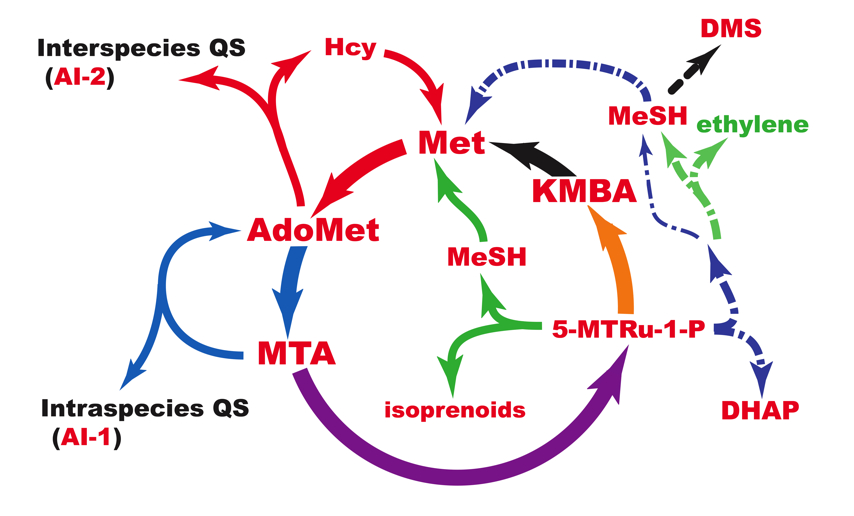 indicated
in figure 9.
The pathway has now been completely unravelled in B. subtilis,
and in several other bacteria, including Pseudomonas aeruginosa.
It remains however not completely understood in several organisms,
such as Thermoanaerobacter tengcongensis.
indicated
in figure 9.
The pathway has now been completely unravelled in B. subtilis,
and in several other bacteria, including Pseudomonas aeruginosa.
It remains however not completely understood in several organisms,
such as Thermoanaerobacter tengcongensis.
In a first step in E. coli, MTA is hydrolysed by a nucleosidase (EC 3.2.2.16, coded by gene pfs, now mtnN), yielding methylthioribose (MTR) and adenine Cornell, 1996 #273; Cornell, 1998 #272. In B. subtilis the corresponding gene yrrU, is present in a complex operon yrrTmtnNyrhABC, that appears to metabolise sulfur containing molecules Sekowska, 1999). In contrast, in animals and their parasites, MTA is phosphorolysed, giving methylthioribose-1-phosphate and adenine. In the case where sulfur is not limiting it happens that MTR is the final product excreted into the medium. This seems to be the case in E. coli (Schroeder, 1973). In order to harmonize nomencalture pfs and yrrU should perhaps be renamed mtnN, for methylthioadenosine nucleosidase (reserving mtnP for the phosphorylase present in several Bacteria, Archaea and Eukarya).
However, MTR is usually recycled (figure 9). In the presence of oxygen, the pathway deciphered in K. pneumoniae begins with phosphorylation of MTR by a MTR kinase, that uses ATP as phosphate donor and produces MTR-1-phosphate (Wray, 1995). MTR-1-P is transformed into methylthioribulose-1-phosphate (MTRu-1-P) by an aldose-ketose isomerase. MTRu-1-P is subsequently dehydrated (and converted into a ketone) by a not yet identified dehydratase, to give 2,3-diketo-5-methylthiopentyl-1-phosphate (DK-MTP-1-P). This latter molecule is first converted into phosphoene-diol (DHK-MTPene) via the intermediate, 2-hydroxy-3-keto-5-methylthiopentenyl-1-phosphate (HK-MTPenyl-1-P), to give 1,2-dihydroxy-3-keto-5-methylthiopentene (aci-reductone). These two steps are catalysed by a bi-functional enzyme, enolase-phosphatase E-1. In K. pneumoniae, 1,2-dihydroxy-3-keto-5-methylthiopentene can be processed in two different ways, by hte action of a dioxygenase E-2 (aci-reductone oxidase) either into formate, 3-methylthiopropionate and CO (Wray, 1993), or, depending on the nature of the transition ion bound to the enzyme (either nickel or iron), into formate and a-keto-4-methylthiobutyrate (KMTB), the direct ketoacid precursor of methionine. Only the second pathway permits the direct way back to methionine thanks to the transamination of KMTB by an original tyrosine aminotransferase (TyrAT), that utilises as an amino group donor glutamate or aromatic amino-acids Heilbronn, 1999) (figure 9). It must be stressed that the carbon atoms 2, 3, 4 and 5 of ribose are found again in the methionine backbone, and that the methyl group carried by sulfur is not exchanged: this recycling process therefore does not require a source of one-carbon residues, but, in contrast, it produces one (in the form of formaldehyde or formate). This fact is quite remarkable (figure 9). Indeed, this production of one-carbon residues in the form of a chain reaction is typically explosive. One expects therefore that methionine metabolism will be particularly stringently regulated to control these explosive reactions. In this context, the storage in the form of S-methylmethionine may be a way to modify rapidy the availabilty of methyl groups.
At this stage, experimental work was needed to identify all the biochemical steps of the pathway. A remarkable work by Yokota and his colleagues established the following, in B. subtilis (). The mtnW (ykrW) gene coding for a RuBisCO-like Protein (RLP) is the first gene in the mtnWXBD operon, located close to the mtnKA operon (Sekowska and Danchin, 2002). These operons have S-box riboswitches that regulate the expression of the genes involved in sulfur metabolism in B. subtilis and other A+T-rich Gram positives. MtnD is highly homologous to the 1,2-dihydroxy-3-keto-5-methylthiopentene dioxygenase and MtnK was identified as the methylthioribose kinase (Sekowsha et al., 2001). This suggested that both operons were functioning in the methionine salvage pathway (figure 9). Therefore Yokota et al. first predicted and proved that B. subtilis MtnA, rather than coding for a translation initiation factor, coded for the first step of MTA recycling; RLP would catalyze a reaction step somewhere in this pathway. Each step of this pathway has been predicted in Klebsiella sp. by analysis of metabolic intermediates but two enzymes, MTR-1-P isomerase and MTRu-1-P dehydratase, were unknown. Moreover, each reaction step in this pathway was uncharacterized in B. subtilis, except for that catalyzed by MTA nucleosidase, MTR kinase and KMTB aminotransferase encoded by mtnN, mtnK and mtnE, respectively. This fact suggested to them that RLP functions as a DK-MTP-1-P enolase in the methionine salvage pathway in Bacillus species. One must remark here the special role played by dioxygenase E-2 (that gives an interesting idea of the general possible function of dioxygenases). Indeed, this enzyme directly consumes dioxygen, O2, and may therefore be utilised to prevent the toxic effects of oxygen (more numerous than we can summarize here, see for example Gardner, 1998). In such a case, the production of MTA (MTR) may be considered as a means (perhaps existing very early in evolution, before the evolving of respiration) to protect the cell against the toxic effects of oxygen. This may indirectly account for the antioxidizing properties of polyamines coupled with their synthesis Lovaas, 1991; Pavlovic, 1992).
Special metabolism of sulfur
We just broadly outlined the general metabolism of sulfur, but it still exists a series of more or less unknown metabolic pathways where sulfur is involved in some way. Sulfur is an element present in molecules as glutathione. It is also a constituent of iron-sulfur centers or of essential coenzymes such as thiamine, biotin, molybdopterin, pantothenate and lipoic acid. It also belongs to the many modifications of the nucleotides that constitute transfer RNA, via reactions that we just begin to understand.
Glutathione
We begin with this cofactor because it is directy associated to cysteine metabolism. Its transfer onto spermidine probably leads to storage of the latter in stationary growth phase (Cohen, 1998). In E. coli, gene gsp is involved in this transfer. The corresponding protein, GSP, is a bifunctional protein that catalyses the formation of glutathionyl-spermidine (glutathionyl-spermidine synthase, EC 6.3.1.8), but also its hydrolysis (glutathionyl-spermidine amidohydrolase, EC 3.5.1.78). The two catalytic activities lie in two distinct parts of the protein, the amidase function is located in the amino-terminal part, whereas the synthetase function is located in the carboxy-terminal part (Swiss-Prot: P43675). There exists also another protein, glutathione S-transferase or GST (EC 2.5.1.18, encoded by gene gst), that tranfers glutathione to several kinds of molecules.
Glutathione is an isotripeptide, very frequently found in cells. It is derived from the condensation of cysteine on the g-terminal COOH of glutamate. A glycine residue is subsequently added by formation of an usual peptidic bond. Glutathione is used to recycle the sulfide groups that can be spontaneously oxidized, following electron transfer due to catalysis or free radicals, or other oxidation phenomena. In the course of this process, two molecules of glutathione form a disulfide bridge that is thus reduced by glutathione oxidoreductase. In E. coli, the genes involved are the following:
• gene gor codes for glutathione oxidoreductase; it is in operon with an unknown gene yhiR.
• gene gshA codes for g-glutamyl-cysteine synthetase; it lies in a likely operon yqaBAgshAygaG (YqaB and YqaA may be phosphatases, similar to the phosphatase of the HPr protein of B. subtilis).
• gene gshB codes for glutathione synthetase; it lies in a likely operon gshByqgEyqgF (YqgE and YqgF display some analogy with phosphotransferases). These unexpected associations suggest an interesting track to explore: is the biosynthesis of glutathione controled by protein phosphorylation?
The iron-sulfur centers
Sulfur is also an element of iron-sulfur centers (minute analogues of iron pyrite) that are involved in a large number of oxido-reductions, and constitute the core of ferredoxins. In the history of the origin of life, hypotheses become more and more convincing that the electron transfers between Fe2+ iron and Fe3+ iron and the numerous possible oxidation states of sulfur play a role of prime importance (Granick, 1957; Wächtershäuser, 1988; Danchin, 1989). It is therefore interesting to wonder how the iron-sulfur centers are formed in the cell.
One knows very little about the formation of elemental sulfur, apart from conditions where it acts in the electron transfers allowing anaerobic respiration (Ehrlich, 1996). It is very unlikely that it is sulfur in this oxidation state that is incorporated in the diverse types of centers (Fe-S)n. A possible start point seems to be cystine, possibly by directly coupling a cysteine to a cysteine present in the protein that carries the iron-sulfur center, using a hydrogenase. A beta-lyase, analogous to cystathionine b-lyase may then provide the thiocysteine that serves as donor of sulfur atom. But it is the study of protein NifS in Azotobacter vinelandii that brings most information on a possible mechanism. This protein is a cysteine sulfurylase that, from thiocysteine, liberates sulfur, yielding cysteine (Zheng, 1998). Several enzymes homologous to the product of gene nifS of A. vinelandi existent in E. coli. One of those seems to code for a cysteine sulfinate sulfinase (Mihara, 1997). The existence of these reactions may provide tracks to assign a function to some genes labeled "y".
Much work in years 2000-2010 has unraveled the pathway of formation of iron-sulfur clusters, starting from a cysteine desulfurase (IscS and related enzymes) that extracts the sulfur atom of cysteine to make alanine and put it on a carrier cysteine sulfur, making a persulfide). "Several IscS-interacting partners including IscU, a scaffold for Fe-S cluster assembly; TusA, the first member of a sulfur relay leading to sulfur incorporation into the wobble uridine of several tRNAs; ThiI, involved in tRNA modification and thiamine biosynthesis; and rhodanese RhdA are sulfur acceptors. Other proteins, such as CyaY/frataxin and IscX, also bind to IscS, but their functional roles are not directly related to sulfur transfer" (Shi et al, 2010).
Thiamine
Thiamine is an essential cofactor comprising a sulfur heterocycle. Its biosynthesis needs two separated pathways. The first synthesizes the thiazole group (5-methyl-4-(-hydroxyethyl)thiazole), and the second a pyrimidine (4-amino-5-hydroxymethylpyrimidine pyrophosphate) (figure 10). These two molecules are combined to yield thiamine pyrophosphate. The pyrimidine moiety is derived from 5-aminoimidazole ribotide. Thiazole is derived from tyrosine, cysteine, and 1-oxy-D-xylulose-5-phosphate. The enzymatic mechanisms involved in the formation of thiazole and pyrimidine remain poorly understood. In particular a synthesis pathway for pyrimidines, related to that of purines, but that does not stem from normal ammonium transfer on PrPP, seems to exist. This pathway involves several genes of unknown function such as apbA, apbE or ybgF (the homologous gene in B. subtilis is yabC). Their inactivation makes the mutants particularly sensitive to serine.
An operon of five genes (thiCEFGH) involved in the biosynthesis of thiamine has been cloned and characterized (Table 2 and figure 10).
Gene thiC complements mutants auxotrophic for 4-amino-5-hydroxymethylpyrimidine, genes thiFGH complement mutants auxotrophic for thiazole, and gene thiE codes for thiamine phosphate synthase. Another gene (thiI), necessary for the biosynthesis of thiazole in Salmonella typhimurium has recently been identified (Webb, 1997). A gene homologous to thiI of S. typhimurium is located at 9.5 min in the chromosome of E. coli and complements a mutation nuvC. NuvC is necessary for the synthesis of the thiouridine present in tRNA and of the thiazole moiety of thiamine. This suggests that ThiI plays a role in the chemistry of sulfur transfer in the biosynthesis of thiazole.
A new observation recently completed this pathway. When the product of gene thiG, purified from a strain that expressed it, has been analysed by mass spectrometry, it appeared that it was in fact made of two proteins. A subunit, now named ThiS, had a mass of 7310.74 Da. The second subunit, for which one keeps the name ThiG, had a mass of 26896.5 Da. In fact, although the mass anomaly of ThiG had been noted before, thiS had escaped attention during the identification of CDSs in the E. coli genome. This was caused in part by the short length of the corresponding CDS, and by the presence of sequence errors (quoted in Taylor, 1998). To this difficulties we may add that ThiS is poorly coloured with Coomassie blue and migrates with the front in the polyacrylamide gels. ThiS contains the -Gly-Gly sequence found at the carboxy-terminal end of ubiquitinylated human red cells. This similarity in sequence was more remarkable because ThiF is similar to an enzyme that activates ubiquitine. The similarity includes the presence of an ATP binding site. This suggested that ThiF may well catalyse adenylation of ThiS, and that the adenylate derivative ThiS-CO-AMP may react with cysteine (or a sulfur donor derived from cysteine) to yield the thiocarboxylate derivative ThiS-COSH (figure 11 B). Furthermore, the double role of ThiI in the biosynthesis of thiazole and 4-thiouridine indicated that ThiI may play a role in the reaction of sulfur transfer. This is what has been proposed by Taylor and his colleagues (figure 11 Taylor, 1998).
The enzymatic mechanisms of sulfur transfer in the biosynthesis of thiamine, molybdopterin, biotin, and lipoic acid remain however poorly known.
Lipoic acid
Thiamine is involved in the anabolic processes of decarboxylation (linked to dehydrogenation), where two cofactors operate successively, thiamine pyrophosphate and lipoic acid. Lipoate is synthesized by insertion of sulfur coming from cysteine into the hydrocarbon chain of octanoic acid (an intermediary in the biosynthesis of fatty acids) at position C-6 and C-8. This reaction is probably performed by a mechanism involving a radical Michal, 1999 #166. The sources of sulfur used for the formation of biotin and lipoic acid are unknown, and the mechanism of insertion of sulfur into the protein has not yet been established. At the end of biosynthesis, a molecule of lipoate activated by ATP is linked to the e-amino group of a lysine of the corresponding enzyme to yield the functional cofactor. Lipoic acid is a cofactor linked covalently to many dehydrogenases, such as pyruvate dehydrogenase (EC 3.3.1.) or a-ketoglutarate dehydrogenase (EC 3.8.1.). Most living organisms synthesize lipoic acid, that must be produced in situ to be functional, and it seems difficult to recover from the environment. However, in some bacteria, lipoate is a growth factor Michal, 1999 #166.
Three genes of the biosynthesis pathway of lipoate have been identified: lipA (lipoate synthase, Swiss-Prot P25846), and lplA and lipB (lipoyl-protein ligases A and B, EC 6.-.-.-, Swiss-Prot P32099 and P30976, respectively). But it is clear that for understanding the whole pathway a lot of data are still missing. One possibly has in E. coli an operon comprising dacA (D-alanine carboxypeptidase), ybeD (similar to yitC of B. subtilis, similar to an oxo-acyl CoA carrier protein synthase) and lipB (LipB links lipoate to the e-amino group of a lysine in a receptor protein, a reaction performed from a complex and not from free lipoate), an operon comprising ybeF (YbeF is an activator of the LysR family, whose effector is unknown) and lipA whose product may be involved in insertion of sulfur during lipoate biosynthesis. There exist two proteins similar to LipA in B. subtilis, YutB (54% identity) and YqeV (23% identity). YqeV is remarkable because it is very conserved in all bacteria, but without known function, with a likely role in the synthesis of lipoic acid (Table 2).
The modifications of transfer RNA
Among the 79 types of transfer RNA modifications that have been identified, at least 50 of which being present in E. coli, three or four involve sulfur-containing molecules (Bjork, 1996).
In E. coli and related bacteria, the nucleotide in position 8 in transfer RNA is a modified uridine, 4-thiouridine. This nucleotide seems to have as its principal role a protective function against violent irradiations by near ultraviolet light Mueller, 1998). Indeed, this nucleotide absorbs radiation at this wavelength and therefore protects the cell. In the presence of sufficient irradiation at 365 nm, this nucleotide reacts with a neighbor cytosine producing a covalent bond. The tRNA molecule thus modified can no longer be charged by the corresponding amino acid, in most cases. This triggers the stringent response, whose signal is the ppGpp molecule, coupling translation to transcription. The macromolecular syntheses stop and bacteria are shifted to a state that permit them to better resist this situation. One does not yet know how the atom of sulfur is incorporated into the nucleotide. Although mutants controlling this process have been isolated more than 25 years ago (nuvA and nuvC Lipsett, 1978), the thiI gene involved in this reaction has only been characterised recently Mueller, 1998). Furthermore, this gene is involved in the synthesis of thiamine.
There exist several modifications at position 34 (first position of anticodon) in E. coli. In the case of tRNAs specific for glutamate, lysine and glutamine, the modified nucleoside is 5-methylaminomethyl-2-thiouridine (mnm5s2U34). The reaction of uridine 34 modification comprises several steps, some of which are poorly known. The first step of thiolation at position two of uridine (s2U34) is catalysed by the product of gene mnmA (also known in the litterature as trmU or asuE). The product of gene mnmE (trmE) catalyses the first step of the modification at position five, but one does not know the steps that lead to the modification into 5-carbonylmethylaminomethyl-2-thiouridine (cmnm5s2U34). The two modifications at position two and five are synthesized independently of each other. The product of gene mnmC (trmC), that catalyses the following step of the modification at position five, possesses two enzymatic activities that catalyse successively the reactions to liberate the acetate group of cmnm5s2U34 (which leads to nm5s2U34, 5-methylamino-2-thiouridine), and to methylate the nm5s2U34 in mnm5s2U34 (AdoMet-dependent reaction) Hagervall, 1998).
The modification at position 34 participates probably in the discrimination between codons of the same family that, varying at their third position, code for different amino acids (for example lysine is coded by two triplets AAA and AAG, which can lead to the confusion with asparagine codons AAU and AAC). However, experience shows that this role is perhaps not direct, because the mutants partially modified at position 34 of tRNA seem to be more accurate in translation (there is less confusion between lysine and asparagine) than the wild type, with a tRNA containing normally modified uridine. The authors propose that this modification has a role in the interactions with the ribosome or with the translation elongation or termination factors, rather than in the direct codon discrimination Hagervall, 1998). In this case, the thiol group present in these modified bases stabilises the structure of transfer RNA, which is centrally important to the reconnaissance of tRNA correspondings by their synthetases and to their charge with their amino acids Kruger, 1998).
At position 32 of some tRNAs of eubacteria, one finds another modification, 2-thiocytidine, but little is known about the genes involved in its synthesis and about the biological signification of this modification Bjork, 1996).
Another modification (2-methylthio-N6-isopentenyl adenosine (ms2i6A), adds a S-methyl group at position 2 of adenine at position 37 of transfer RNAs specific for codons beginning with U, with the exception of tRNASer I and V). It may result from the transfer of the methyl group of AdoMet, whereas sulfur atom would come from cysteine. Two genes, miaB and miaC, are necessary for this reaction. Gene miaA catalyses the first step of conversion of adenosine into 6-isopentenyl-adenosine Esberg, 1995). The position of these genes in the chromosome of E. coli was not clearly established until recently. The miaB gene has been shown to be identical to gene yleA. MiaB contains a cysteine cluster reminiscent of iron-binding sites. It is therefore assumed that it participates in the thiolation step of tRNA Esberg, 1999). In S. typhimurium, a fourth gene, miaE, oxidizes 2-methylthio-N6-(isopentenyl)-adenosine into 2-methylthio-N6-(4-hydroxyisopentenyl)-adenosine (ms2io6A) Persson, 1998).
Some modifications of tRNA are important for cellular metabolism (in S. typhimurium), or virulence (in Shigella) Bjork, 1999 #246. Among others, these modifications concern position 37, such as the modification of adenosine just described (ms2i6A), or the modification of guanosine catalysed by tRNA(m1G37)methyltransferase, encoded by gene trmD (1-methyl-guanosine (m1G37)), or another modification of guanosine at position 34 in queuosine.
The molybdenum coenzyme (molybdopterin)
With the exception of nitrogenase, in all molybdoenzymes, the atom of molybdenum belongs to an organometallic structure named the molybdenum cofactor (MoCo). In this structure, molybdenum is linked to its organic ligand by a dithiolene group located in the 6-alkyl chain of molybdopterin (MPT). In E. coli, MoCo is present in the slightly different form of molybdopterin guanine dinucleotide (the conversion of MoCo in dinucleotide is placed just before incorporation of the cofactor in the protein). The biosynthesis of MPT starts with GTP as a precursor (figure 12). There are several steps, that comprise the opening of the GTP cycle, lead to the direct precursor of MPT, precursor Z Wuebbens, 1995). This latter molecule is a 6-alkylpterine with a phosphate group at the extremity of the aliphatic chain. This phosphate group leads to the formation of a six atom heterocycle by using two carbons of the chain (C-2' and C-4') (figure 12). Precursor Z contains none of the sulfur atoms present in MPT. The conversion of precursor Z into molybdopterin necessitates ring opening of the heterocycle and transfer of sulfur to create the dithiolene group needed for the chelation of molybdenum.
The transfer of sulfur in the biosynthesis of thiamine and molybdopterin follows the same course. A system of three enzymes (MoeB, MoaD, and MoaE) permitting the transfer of sulfur to precursor Z of molybdopterin has been reconstituted in E. coli Pitterle, 1993; Pitterle, 1993) and in Aspergillus nidulans (figure 12) Appleyard, 1998).
The first enzyme, MoeB (also known as ChlN), molybdopterin synthase sulfurylase, is responsible for the activation of MoaD by adenylation, as well as the transfer of sulfur to activated MoaD Appleyard, 1998). MoaD (small subunit) with MoaE (large subunit) form molybdopterin synthase (known in the litterature as "converting factor"). This enzyme possesses two catalytic activities: opening of the cycle created by the phosphate group and sulfur transfer on precursor Z. Protein MoeB is very similar to ThiF; MoaD and ThiS comprise the same Gly-Gly dipeptide at their carboxyl-terminal end. One can therefore think that sulfur is transfered in the same way by adenylation followed by formation of thiocarboxylate, as in the case of the biosynthesis of thiamine Taylor, 1998 (see figure 11).
In E. coli the genes involved in the biosynthesis of MPT are situated in two operons: moeA (function unknown) moeB, and moaABCDE. moaABC have an unknown function (Table 2).
Biotin
Apart from the metabolism of energy, transamination and decarboxylation are the two most central steps of intermediary metabolism. In general, transamination is involved in anabolism, while decarboxylation is most often a first step of catabolism (cf. Danchin, 1990 #49). A particular coenzyme, biotin, plays a central role in many decarboxylation reactions (but also carboxylations and transcarboxylations). Although generally essential, this coenzyme is rare in nature. For this reason, living organisms have developped many systems to capture and transport biotin. These systems are so powerful that they have been used as probes in many processes used in molecular biology. The biotin/(strept)avidine couple is often more efficient and more specific than the antigen/antibody couples. One can use biotin and streptavidine to the coupling of a reaction (molecular hybridization for example) with an enzymatic amplification system Prescott, 1999).
Biotin is synthesized by bacteria, yeast and plants essentially in the same way. However, this biosynthesis is not completely understood, and in particular one does not yet know how sulfur is incorporated into biotin. It begins probably by the condensation of three molecules of malonyl-CoA into pimeloyl-CoA with liberation of two molecules of carbon dioxide. Subsequently, the condensation of pimeloyl-CoA with alanine (pyridoxal-phosphate-dependent) leads to the formation of a molecule of 8-amino-7-oxopelargonate (KAPA) with the liberation of CO2 and CoA-SH. KAPA is then converted into 7,8-diaminepelargonate (DAPA) by a transamination reaction. This reaction involves S-adenosylmethionine as an amino group donor. An ATP-dependent carboxylation leads to the closing of the imidazolidone cycle and to the formation of dethiobiotin. The last step, that places sulfur in the molecule (is still an unidentified mechanism, because it can neither be sulfur S0, nor an iron-sulfur center, but probably of sulfur coming from a protein with an iron-sulfur center, perhaps biotin synthase Bui, 1998 #339, yields biotin by the closure of the thiophane cycle Michal, 1999). Because biotin (vitamin H) is an important food supply, its production is of industrial interest.
In E. coli, we know that the synthesis of biotin is controled by genes linked to locus galETK (lambda phage deletions often lead to auxotrophy for biotin), but all the steps are not yet known. Two operons containing genes involved in the synthesis of biotin are lying next to each other in a divergent way. One has therefore possibly an operon of three genes: bioA (acid diaminepelargonic synthetase), ybhB (unknown gene that is similar to yxkA of B. subtilis (31% identity), itself similar to ... bioA) and ybhC (weakly similar to YdgB of B. subtilis (29% identity), without known function). The divergent operon comprises four genes: bioB (coding for biotin synthase), bioF (coding for 7-keto-8-aminopelargonic acid synthase), bioC (function unknown, the mutant of this gene is blocked in the formation of pimeloyl-CoA) and bioD (coding for dethiobiotin synthase). Gene bioH is located elsewhere in the chromosome, and its function is not known but the corresponding mutant is blocked in the formation of pimeloyl-CoA.
Pantothenic acid and coenzyme A
The presence of membranes in the form of a lipid bilayer is a universal feature of life. Lipids, and especially aliphatic long chain fatty acids, are ubiquitous constituents of membranes. To know their biosynthesis is therefore crucial to understand the metabolism of living organisms. This biosynthesis is based on the synthesis and degradation of a thioester bond, which have an ancient origin and probably started before the origin of life. The mobile arm in these reactions catalysed by ACP (Acyl Carrier Protein), is 4-phosphopantetheine. In some reactions this arm is linked to a nucleotide, and forms coenzymeA (CoA, or "acyl carrier group"). The biosynthetic mechanism of CoA synthesis is not entirely known, although the main enzymatic steps have been identified (figure 13).
Thee precursor of panthothenate biosynthesis is 2-oxoisovalerate, the valine transamination product. 2-oxoisovalerate is methylated by 5,10-methylene-THF, giving 2-hydropantoate, which is subsequently reduced into pantoate. An ATP-dependent condensation of the latter with b-alanine (derived from aspartate a-decarboxylation, or from pyrimidine degradation) yields (R)-pantothenate. This latter product, which is strongly excreted by E. coli, is source of this vitamin for mammals Michal, 1999).
Coenzyme A is synthesized by all organisms from (R)-pantothenate that is first phosphorylated in (R)-4'-P-N-pantothenate. Its condensation with cysteine in presence of CTP produces pyrophosphate, CMP and (R)-4'-P-N-pantothenoyl-cysteine. Following decarboxylation, one obtains 4'-P-pantetheine. Phosphopantetheine adenylyltransferase (PPAT), produces dephosphoCoA Izard, 1999), that is subsequently phosphorylated by an unknown dephospho-CoA kinase to give the final product, CoA.
The 4-phosphopantetheine group of CoA is transfered on a serine residue of ACP (apo-ACP), the core protein of the fatty acids biosynthesis enzymes and also of peptide antibiotics. The same mechanism operates for the formation of an active protein EntF, necessary for the syntehsis of siderophores Gehring, 1998). At this step, there is liberation of 3'5'adenosine diphosphate (PAP), the same molecule that is liberated during assimilation of sulfate, and that is hydrolysed in 5'AMP by the product of gene cysQ. It is therefore important to notice that PAP creates a possible link between sulfur assimilation, lipid biosynthesis, iron transport and antibiotic biosynthesis.
In E. coli, the few genes involved in the biosynthesis of pantothenate and of CoA are distributed in several operons dispersed in the chromosome (Table 2). They are indicated in figure 13. We have operon panBC where panB codes for ketopantoate hydroxymethyltransferase, EC 2.1.2.11 and panC coding for pantothenate synthetase "panthoate activating enzyme", EC 6.3.2.1. Gene panD codes for aspartate 1-decarboxylase, EC 4.1.1.11 and coaA codes for pantothenate kinase, EC 2.7.1.33. The operon kdtAB, where kdtB has been wrongly annotated in Swiss-Prot, codes for phosphopantetheine adenyltransferase Izard, 1999). Finally, operon rnc era recO pdxJ acpS contains acpS that codes for holo-ACP synthase (EC 2.7.8.7).
Some elements of regulation
Such a complex metabolism requires an important coordination. Indeed, there exist, in E. coli, at least four general regulators (without counting specific regulators) that coordinate sulfur utilisation both in the anabolic and in the catabolic direction. Three of these regulators, CysB, MetR and Cbl, are LysR-type activators Greene, 1996; Kredich, 1996; van der Ploeg, 1997). The regulators of this family (more than one hundred are known) are similar to each other in a region of about 280 residues, comprising in its amino-terminal end a DNA binding site, the"helix-turn-helix" motif Schell, 1993). To these regulators we can add protein MetJ, that has a totally different structure, with almost no equivalent among the proteins known to bind DNA Greene, 1996).
CysB is a tetramer composed of identical subunits (Mr = 36 kDa), that controls expression of genes involved in the biosynthesis of cysteine in Gram negative bacteria. This system comprises many genes associated to sulfate transport, to its reduction into sulfide and to the formation of cysteine from serine and acetyl-CoA Kredich, 1996). CysB is a transcriptional regulator that acts as an activator of transcription. It is also the repressor of its own synthesis (it is generally the case of LysR type regulators). The activity of CysB is modulated by a cofactor, N-acetylserine. As we have seen, O-acetylserine (the direct precursor of the synthesis of cysteine) is not stable. By internal cyclisation and transfer of the acetyl group, O-acetylserine leads to a more stable molecule, N-acetylserine. It is this molecule that plays the role of probe for the available level of O-acetylserine in the cell, and regulates the cysteine biosynthesis pathway.
As in the case of many promotors functioning in the presence of an activator, the promotors of genes under the control of CysB possess a "-35" region that differs from the consensus sequence of sigma factor 70 (TTGACA). The activation promotors of this type necessitate the fixation of the activator upstream from region "-35", which facilitates the formation of transcription initiation complexe Kredich, 1992). It is difficult to predict the interaction sites of LysR type regulators. Their experimental identification Schell, 1993 leads several authors to describe a consensus binding sequence for CysB to DNA Hryniewicz, 1995). But because of its length and its small number of conserved residues TTANTNcNNtTNNNNNTNN and NNATNNNNAaNCNNTNNNT a consensus of this type is probably without much significance. One must also remark that, curiously, the authors have never made a statistical study of the corresponding sequence. As we can see, the usual search for consensus sequences (generally disputable Hénaut, 1996) seems therefore particulary ill suited to proteins of this type and to their operators.
The underlying molecular mechanisms were not really understood until recently. One often remarked that the binding sites of these activator proteins apparently occur in strongly curved regions of DNA. Indeed, one finds CysB in the control of other responses where the supercoiling and the curvature of DNA have been noticed, such as the adaptation to acid Rowbury, 1997). The analysis in electron microscopy of the structure of sigma 70 promotors, during transcription initiation, leads to a remarkable observation. It seems established that DNA circles completely the molecule of RNA polymerase, forming a superhelix with a very small diameter (10 nm), which involves a strong DNA curvature at the promotor, placing the -70 region and the +24 region of promotor in close vicinity Rivetti, 1999). One therefore understands that the stabilisation of curved structures could help transcription initiation. One must also stress that there exists a phenomenon of winding of the double helix, that can play an important role. This is illustrated by the promotors controlled in B. subtilis by factor Mta (Multidrug transporter activation), a member of the family of transcriptional regulators MerR, which have regions -10 and -35 spaced by 19 base pairs instead of 17 (Baranova et al., 1999). One does not know yet, in the case of CysB, the relative contributions of the bending and torsion of the promotors that it regulates.
In the same way as we do not know their operators, it is difficult to identify the effector molecules for LysR type regulators. One has identified in vitro an inducer of CysB, but sulfide and thiosulfate inverse the effect of N-acetylserine on its binding with the promotors of regulon cys. They inhibit transcription initiation by exerting an anti-inducer role on CysB. The absence of physico-chemical kinship between these diverse molecules pose the question of identification of molecules that bind to CysB.
The CysB protein has been crystallised, and its three-dimensional structure is known. The crystal has been obtained from a solution saturated in ammonium sulfate, then passed through several steps of sieving and purification in solutions containing no sulfate. However, in the crystal, a sulfate ion rests at the core of the protein. The authors of this work did not expect to find this ion there, although one could naturally expect its presence as regulator of this metabolic pathway Tyrrell, 1997). The sulfate ion is likely to be placed at the binding site for N-acetylserine, that seems be the true inducer of the pathway Lynch, 1994). One can therefore wonder whether sulfate does not play an antagonist role to N-acetylserine, for example to repress the pathway for sulfate transport. Another possibility is that the binding site of sulfate is the natural place of thiosulfate, that although structurally similar to sulfate, is an anti-inducer of regulon cys Tyrrell, 1997). Finally, this observation of the presence of sulfate in the inducer binding cavity is very interesting because of the very strong similarity of the three-dimensional structure of proteins of the LysR family (CysB in particular) with periplasmic proteins binding sulfate Tyrrell, 1997). It remains however to be proven that this is really a biologically significant phenomenon. This is the more so if one remarks that CysB comprises a sequence (YVRLGLGVGVIASMAVD) which is remarkably similar to that of the consensus sequence of several AdoMet binding proteins [AMLIVF] [AMLIVF] [DE] [AMLIVF] G X G X G X [AMLIVF] X X X [AMLIVF] [AMLIVF] [DENQRKHST] (Wu, 1992, Sekowska et al. 2000), suggesting that AdoMet could also modulate its activity. In B. subtilis the corresponding regulation is indeed performed by AdoMet, but on S-box riboswitches (ref).
The regulator Cbl is an activator of operon tauABCD and other genes belonging to the SSI class – "sulfate starvation-induced" in cooperation with CysB van der Ploeg, 1997). One knows little on the operators recognized or on the effectors involved.
As for the pathway of cysteine biosynthesis, the pathway of methionine biosynthesis possesses also its regulators. MetR is an activator of expression of genes glyA, metE and metH and probably also of gene metF Cowan, 1993). The activation by MetR necessitates the presence of homocysteine as coactivator in the case of glyA and metE or as co-repressor (in the case of metH) Plamann, 1989), the mechanisms of activation by this activator are not understood.
It remains finally an original regulator, MetJ, that controls the synthesis of methionine in reponse to AdoMet (for a review see Greene, 1996). MetJ belongs to the small class of transcriptional regulators that bind DNA by a motif "ribbon-helix-helix" (RHH) and not with "helix-turn-helix" as most regulators do in bacteria. This family contains, in addition to MetJ, the two repressors Arc and Mnt of bacteriophage P22 of S. typhimurium He, 1992). The regulators of the HU family of B. stearothermophilus also belong to this class Vis, 1994). Protein MetJ is a dimer composed of two identical subunits (Mr = 12 kDa), that regulate expression of all genes involved in the biosynthesis of methionine (with the exception of metH) and of gene metK coding for SAM-synthase Greene, 1996). It also regulates its own expression Saint-Girons, 1984). MetJ binds upstream sequences of genes that have two to five repeats of the eight nucleotides 'AGACGTCT', the "methionine box". Each methionine box acts as a recognition site for a molecule of repressor. However, one needs at least two boxes to bind a molecule of repressor. The number of repeats (and their similarity with the consensus) determined the number of repressor molecules that will bind, and therefore the level of repression. MetJ is an aporepressor, that for its activity needs a co-repressor, AdoMet, whose affinity for the aporepressor is weak (Kd = 200 mM). The dissociation constant of the repressor-operator complex is of 1 nM in the presence of AdoMet and 10-fold less in its absence Saint-Girons, 1986).
As we can see, the regulation of sulfur utilisation and the corresponding enzyme activities involve various and complicated mechanisms that are not always well understood. This regulation is linked to the methylation potential of the cell (it is the role of AdoMet) and possibly also to its oxido-reduction potential. The very nature of sulfur leads us to investigate the processes that permit the cell to manage its many oxidation states.
The situation in many organisms, and in particular in E. coli, is complicated because the metabolism of sulfur is associated to that of another atom, with a particularly enigmatic role, selenium.
Selenium and sulfur
Selenium is an element both indispensible and very toxic to living organisms. Its "normal" intracellular concentration is only ten-fold lower than the concentration for which selenium becomes toxic. This implies that the cell must manage the transport and the mechanisms of detoxification of this element. Selenium, that is very similar to sulfur, is the element immediately below sulfur in the same series of Mendeleieff table. It can therefore very easily take its place inside biological molecules. Selenium's atomic radius is however larger than that of sulfur, which means that the bonds involving selenium atoms are much longer and weaker. Replacement of sulfur by selenium therefore changes the form of molecules or the distances between the atoms. Moreover, the chemical properties of selenocysteine and cysteine are very different. As a consequence, at physiological pH, the selenol- group (–SeH) of selenocysteine is principally ionized, whereas the sulfhydryl group(–SH) of cysteine is principally protonated.
It follows that incorporation of selenocysteine in proteins has a very strong effect on their tertiary structure, and alters the catalytic activity of residues comprising an atom of selenium. The chemical differences between selenomethionine and methionine are not that important, but the sensitivity to oxygen of the former is however higher. The toxic effects of selenium are therefore due to the substitution of sulfur, leading mainly to the formation of selenocysteine.
Selenium is also more easily oxidized than sulfur. As sulfur, elementary selenium is not soluble. Its oxidized forms (selenate and selenite) are very soluble and constitute the source of selenium for the cell. Selenium oxides play in biological systems the role of a strong oxidizing centre. Selenite is an extremely toxic compound because it reacts with the sulfhydryl groups of glutathione (GSH) or of cysteine, producing molecules of the type RS–Se–SR or RSSR and Se0. The reaction of selenite with thiols produces also H2O2 and O2-, participating to its toxicity and giving it a mutagenic role Kramer, 1988).
Because of the significant chemical similarity between sulfur and selenium, many organisms do not know how to discriminate between these two elements. Selenium enters in the pathway of sulfur assimilation, and it is non-specifically integrated in various molecules, that normally contain sulfur. The proportion of sulfur replacement by selenium depends on the intracellular concentration of these two elements, but also on the affinity of enzymes involved in these sulfur assimilation pathways, vis-a-vis substrates containing sulfur or selenium.
However, there exist systems permitting biological discrimination between sulfur and selenium. A first example is specific insertion of selenocysteine in some proteins, in the presence of codon UGA in the corresponding messenger RNA. Thus, selenocysteine plays the role of twenty first amino acid of the genetic code. The synthesis of selenocysteine is separated from sulfur metabolism. It begins with a transfer RNA carrying an activated serine. In this case, selenium stems from monoselenophosphate, a molecule synthesized by selenophosphate synthase (product of gene selD) from selenide (HSe-) and ATP Lacourciere, 1998). Monoselenophosphate is also the selenium donor for the conversion of 2-thiouridine into 2-selenouridine in some tRNAs. The selenoproteins have an important role in the anaerobic metabolism of E. coli (for example the formate hydrogenase Axley, 1990).
A second example of biological discrimination between sulfur and selenium exists in plants. It is useful to understand what happens in bacteria. It is manifested by greater tolerance to selenium, which is thus accumulated in a large number of organic molecules (Se-methylselenocysteine, g-glutamyl-Se-methylselenocysteine or selenocystathionine). Most plants resistant to selenium belong to the genus Astragalus (Fabaceae). They are characterised by: (i) a strong accumulation of selenium in the form of Se-methylselenocysteine, (ii) enhancement of selenium tolerance, and (iii) a strong reduction of selenium incorporation into proteins Neuhierl, 1999). Until very recently, the mechanisms of resistance of plants to selenium, were not clearly established. One supposed that this resistance was linked to the presence of enzymes that, in recruiting storage metabolites containing sulfur, they transformed them into selenium derivatives that could no longer be incorporated into proteins. Indeed, a methyltransferase specific for selenocysteine (selenocysteine methyltransferase) that uses S-methylmethionine as donor of methyl group has been purified in Astragalus bisulcatus (species tolerant to selenium) Neuhierl, 1999). In A. bisulcatus, selenium is metabolized by the sulfur assimilation pathway, which leads to the formation of selenocysteine, as primary compound. Selenocysteine is subsequently methylated very efficiently by selenocysteine methyltransferase, which prevents incorporation of selenocysteine in these proteins or others molecules containing sulfur. It is probable that this compound is subsequently discarded and/or stored in vacuoles, but this remains to be seen.
In E. coli, there exists a homologue of selenocysteine methyltransferase, homocysteine methyltransferase encoded by gene mmuA. This enzyme presents only a slight preference for selenohomocysteine as compared to homocysteine, whereas the enzyme from A. bisulcatus is specific for selenohomocysteine or selenocysteine. It is very likely that the two enzymes are related, and that the enzyme involved in detoxification has evolved from an ancestral protein which did not discriminate between sulfur and selenium.
The specificity for S-methylmethionine (and probably also for the S(+) isomer of S-adenosylmethionine) is unusual for methyltransferases. However, the two methyltransferases described above use S-methylmethionine as donor of methyl group, this product being abundant in plants. Furthermore, both enzymes can use the non-physiological stereoisomer of AdoMet (a spontaneous product of the racemisation of groups coordinated to a sulfur atom). In addition to the role of these enzymes in the detoxification and catabolism of S-methylmethionine, they may thus have a function in the scavenging of these molecules Neuhierl, 1999).
Concluding remarks
Sulfur is an essential component of cells. It has been associated to life from its very early steps, and it still plays a role of major importance in life. In E. coli, among the ca 4,500 genes in the genome, more than one hundred genes are directly involved in some step of sulfur metabolism. Analysis of Table 2 suggests that many more genes are probably related to sulfur in a way or another. Curiously enough, not much work has been devoted not only to the identification of many metabolic steps involving sulfur, but also to the regulation of sulfur availability, disposal or to the metabolic steps controlled by sulfur containing molecules. We hope that the present work will be an incentive for further exploration of this enigmatic domain of gene functions, especially in the context of genetics of genomes.
Acknowledgements
We wish to thank Dr Dong-Yan Jin for careful reading and constructive comments on the manuscript, Drs Philippe Bertin, Nicolas Glansdorff, Philippe Glaser, Isabelle Martin-Verstraete and Marc Salomé for their constructive comments in preliminary stages of this review, and Dr Chun-Kwun Wun for his constant encouragement. Pr Art Aronson pointed to us that sulfur metabolism in Gram positive bacteria has to be investigated in depth, since it appears that bacteria such as Bacillus subtilis lack the ubiquitous peptide glutathione. We now know that it is replaced by another cysteine-containing metabolite, bacillithiol.
Figure captions
Figure 1. Sulfate assimilation pathway and cysteine biosynthesis in Escherichia coli.
Figure 2. Methionine biosynthesis in Escherichia coli.
Figure 3. One-carbon residues cycle. On a souligne in the figure the cycle leading to thymine synthesis, in which tetrahydrofolate is not simply recycled as a coenzyme, but used as a substrate (thick arrows).
Figure 4. Comparison of cystine and diaminopimelate structure.
Figure 5. Methionine recycling. In the figure are represented known pathways, presumed pathways, and unknown but likely pathways. There certainly exist other pathways that we were not able to imagine. 1 : O-acetylserine sulfhydrylase, 2 : cystathionine g-synthase, 3 : cystathionine b-lyase, 4 : methionine synthase, 5 : O-acylhomoserine sulfhydrylase, 6 : SAM synthase, 7 : SAM methyltransferase, 8 : adenosylhomocysteine nucleosidase, 9 : cystathionine g-lyase, 11 : S-methylmethionine:homocysteine methyltransferase, 12 : enzyme yielding MTA (e.g. spermidine synthase), 13 : pathway for MTA recycling (see figure 9), 14 : methionine aminotransferase, 15 : KMBA decarboxylase, 16 : 3-methylpropionate lyase, 17 : methanethiol dioxygenase, 18 : methionine g-lyase (this enzyme donne, in addition to methanethiol, ammonium and 2-ketobutyrate), 19 : sulfate assimilation pathway (see figure 1).
Figure 6. Polyamines biosynthesis in Escherichia coli.
Figure 7. Biosynthesis pathway for ethylene in plants.
Figure 8. Structure of the S-adenosylmethionine derivatives.
Figure 9.Methylthioribose recycling in Klebsiella pneumoniae.
Figure 10 Taylor, 1998 #207: Pathway generally admitted for the synthesis of thiamine in E. coli.
Figure 11 Taylor, 1998 #207: Activation of ubiquitin ThiS and mechanism of formation of ThiS-COSH. A. Reactions catalysed by enzyme activation of ubiquitin. One shows only the COOH-terminal end of the protein and the thiol group of cysteine in the active site of the enzyme activating ubiquitin. B. Sulfur transfer in the biosynthesis of thiazole.
Figure 12 Appleyard, 1998 #288: Structure of molecules and metabolic pathway for the synthesis of the molybdenum cofactor in Aspergillus nidulans.
At the beginning of the metabolic pathway, a derivative of guanosine is converted into precursor Z. Sulfur is subsequently added to precursor Z to form the thiolene active group.
Figure 13. Coenzyme A and Acyl Carrier Protein biosynthesis pathway.
Go to Top