
Science and technology: a Western imbroglio
Antoine Danchin ©
2004-2023
唐善•安東
 Une vue très brève en Français se
trouve à ce site, mais une version détaillée est développée dans La
Barque de Delphes.
Une vue très brève en Français se
trouve à ce site, mais une version détaillée est développée dans La
Barque de Delphes.
This lecture formed part of a research programme set up with the aim of developing an uncommon aspect of anthropology, namely the anthropological analysis of Western civilisations by non-Western scholars (with their own definition of who a scholar is) based on an idea proposed by Anne Retel-Laurentin for medical research.
Our Western civilisations tacitly assume that our values are universal. As 'proof', we usually demonstrate that our know-how is the most efficient in the world, thus assuming that our know-how is a value, is the value. While it is difficult to dispute the immense success of Western civilisations, especially in dominating the world, this success often represents a deadly power. It therefore seems worthwhile to reinvest in the roots of our science and technology. In this lecture, the author suggests that there are several distinct traditions at work in our civilisations that carry immense power. From this analysis, it emerges that we must be careful not to identify progress with advancement, the former having a moral side, which is of major importance. Man and societies are not mechanical devices, and should not be treated as such.
This indicates that while it is obviously extremely important not
to regress to pre-scientific sentiments and beliefs, such as those
often displayed by some self-proclaimed 'environmentalists', it is
equally important not to identify science with technology. This
means that we must also be careful not to follow the lines indicated
by the priests of a new religion, even if it pretends to be Science.
Only then will the Earth escape a miserable fate.
It is impossible for me, given our current political environment, to take part in a transcultural programme without saying a few words about these political events. Indeed, as I shall try to show, speaking about science is an effort to attain a "zero level" (as Roland Barthes would probably have called it) in the exchange between civilisations, thanks to the production of concepts that are interpreted as universal. But science - as a generator of progress and as an invader of the world - is of Western origin. One would be mistaken, however, if one imagined that science is produced by the West on an habitual basis, or that Western civilisations and science are one and the same entity. As I shall try to show, the scientific attitude is universal in Man. What is original is therefore not science, but the method that is linked to it, which generates the concepts in which science is rooted, thus fostering constant progress.
The West does not however use this method (which I usually refer to as the Generative Critical Method), everywhere or with any great frequency, despite the fact that it was discovered there. For Western civilisations are made up of the overlapping of several civilisations, more or less antagonistic, or even irreconcilable. It is thus possible to identify in the Western world at least two important traditions, an Indo-European (or Aryan) tradition, that of the " three powers" described by Georges Dumézil, and a Greek/Egyptian/African tradition, the birthplace of which is rather uncertain, and from which stem most specificities of Western science.
Three symbolic characters summarise the whole of the first tradition. They are: the priest, the ploughman and the soldier. Dumézil has tried throughout his life —and this is not the place to discuss the validity of his assumptions and conclusions— to justify his model by identifying myths or legends present from the heart of India through to the Middle East to the extreme borders of Scandinavia and Ireland. He claimed that he could find the idea of a separation of power between those who create (or receive) knowledge, those who make it technically available, creating the know-how, and finally those who enforce it through the power of arms. The speeches that we hear today about a new world order, clearly imposed on the world through brute force, fully justify this interpretation of Western behaviour (I reiterate that the West (in this case) goes as far as Asia, since it is from Indian descent). But does gun power, or arms-mediated persuasion really allow the creation of concepts upon which know-how can be built? Dumézil, who tried to reach universality, remarks (perhaps with some bitterness) that, although he was able to find a place for most Western traditions, he was unable to classify all myths and epics in the three powers. Indeed, the myths of a famous people were far from conforming to the standard: "The originality of Greek facts in the Indo-European ensemble is not isolated: the Greeks, in spite of the fact that their language has kept so many archaisms from a common source, and that their vocabulary has a more pronounced Indo-European appearance than most of its sister tongues, have, in their civilisation and in their religion, less relics and relics more limited than most brother peoples. This is the price to pay for the Greek miracle, as I have said: in this part of the world, a critical and creative mind was early at work, transforming even what it was preserving". Thus the Greek tradition, which is at the root of the method which produces science and makes it progress, does not come from the three powers.
Western civilisations rest on both traditions, which are more or less in open conflict as time passes. The latter produces abstractions, it is in a way disembodied, creative and tolerant; the former is commercial, military, intolerant and destructive, but also utilitarian, efficient and remarkably able to use the latter. The historical consequences of this situation are numerous. In particular it should be noted that conflicts arising between these two traditions generally result in the domination of the former, which takes hold of the concepts generated by the latter and transforms them into means of ruling the world (using the farmer and/or the soldier for that purpose, the priest being there to justify domination). However, at some point, its lack of ability to produce new concepts results in political weakness, and an inability to manage an everchanging environment (be it only because of the demographic increase). In this situation where the three powers are weakened, the latter becomes stronger and generates new concepts that will, in turn, be used to create know-how. Thus an endless spiral is generated upon which Western history —and soon the World's history— is written. And one should perhaps, on a smaller scale, and not on a historical scale, notice how the first of the three powers elevates the scientist from his initial position to the sacred position of the priest, thus effectively sterilising his creative activity, which must be linked to modesty in terms of true scientific production, to function properly... But this would take us far from our subject.
The Generative Critical Method
Rather than ask questions about the true nature of science, I shall, in what follows, concentrate on the modes of knowledge production, and try to emphasise the original aspects of the Greek mode of this production. It should be made clear at this point that it is a rather simplified view, that cannot take into account local variations: it would certainly be possible to find examples that run counter to my general outline. But this outline enables us to understand both the originality and the effectiveness of this approach.
A human being is born in a given civilisation, and soon learns a given language. This is so natural that one hardly considers it as important. It is clear however that, during the learning period, nobody would think of calling into question the knowledge and the rules he or she is acquiring. We start looking at the world through preconceived ideas. The first postulate that will form the basis of the original mode of exploration which I wish to advocate, is that reality (the world) does not speak. This is not, at least in our Western civilisations, a generally accepted idea. On the contrary. It is a Greek idea, expressed for example by Xenophanes of Colophon ("And for a certain truth, no man has seen it nor will there ever be a man who knows about the gods and about all the things I mention. For if he succeeds in the end in saying what is completely true, he himself is nevertheless unaware of it; and opinion is fixed by fate upon all things"), but which is absolutely contrary to the Indo-European tradition of the Book (which claims everywhere to be our only tradition and truth) according to which a special divinity would have communicated some of its knowledge through a fundamental process of Revelation. In fact, there are two independent traditions involving writing in our civilisation. In one tradition, writing is the divine source of knowledge that can only be used as a reference, and never be amended or transformed, while in the second one —the Greek tradition— the book is the starting point for the writing up of new books, new models of the world. In this latter case the book is simply an instrument of knowledge, not a sacred memory.
If reality is mute, however, we can only start from what we have inherited from those who preceded us, and build up an image of the world. And because we are the creators of this image, we are able to understand its behaviour, and how it will answer our questions. When studying the behaviour of this representation, it is necessary to evaluate its relationship to reality by its capacity to predict some of the behaviour of an otherwise incomprehensible world. And it is this power of prediction, which will measure the degree of appropriateness of the model as it relates to the world, something that we shall try to improve with time. The purpose of the method is to generate models of the world that will with time become increasingly suitable. Before continuing, it is worthwhile noting here that there is no reason that a unique model of the world should exist at any given time. It is perfectly admissible to produce several representations of the world at the same time, each of which has its own degree of appropriateness and its own power of prediction. It is important to understand that, by its very nature, a model is different from the reality it represents. In fact one must recognise that acting on a model is not the same as acting on reality... But let us go back to the construction of a model.
One can separate from preconceived ideas, a set of ideas that will not be called into question, at least for some time (this is the dogmatic part of a theory). This set of postulates must be translated into elements on which the model will be built, through a process of abstractive interpretation. For example, a man or an animal is represented by a model, (as is the case in ancient Chinese medicine), and answers to appropriate questions will be tested on it. In a more general abstract way, and the most often in science, the postulates will be translated into clear propositions that, according to the rules of logic, are themselves subject to discussion - and are indeed discussed - forming axioms and definitions. Putting axioms and definitions together will result in a demonstration yielding a theorem or, most often, a conjecture (of a theorem).
We can have here two types of models, a concrete one (the mock-up) and an abstract one (the mathematical model), that we must now situate within the reality they are meant to represent (according to phenomenology) or explain (according to « ontology », using René Thom's words). A new process, symmetrical to that which has provided the bases for the model, an interpretation, which in this case could be termed instantiation, is once again necessary: one must go back to the real world. This is carried out through experimental predictions that are of two different types. Either they are existential predictions (one must discover the object, or the process whose existence has been predicted) or predictions that can be verified, and therefore subject to falsification (an experimental system will have to be constructed to verify or falsify the prediction). Thus the reactions of reality towards the experiment will allow validation of the model, therefore giving a measure of its adequacy. It should be stressed here that persistence of a model through time does not at all justify identifying it with Reality. This is where analogical confusion (metaphores) becomes a risk, as Maupertuis remarked (in his Vénus physique): "Analogy delivers us from the need to imagine new things, and from another, still worse pain, which is to stay in uncertainty. It pleases our mind, but does it please Nature?" Producing models is, in a certain way, producing analogies, and there is a risk that, when one uses a similar model to represent two different phenomena, this will be thought to mean that both are explained by an identical cause. In fact this is just a measure of our inability to display more imagination: one knows, for instance, the symbolic function of integers in the representation of the world in every civilisation; it always uses small numbers (which can be easily understood), but this does not mean that the structure of the world follows such simple arithmetics. To say that the number of man is 3, of woman 4 and perfection (God) 7 (union of male and female) as is found in many civilisations is not very surprising, because this is simply a combination of small figures, and this does not say much about the world (there are indeed civilisations where 2, 3 and 5 play the same function as the former figures; what would be surprising would be if the number 573 695 125 998 331 revealed a specific aspect of reality, but I doubt it!)
One must therefore avoid taking the model for reality, or for any "universal" feature of reality, to allow for the generative process that will now be described. It is the model's inadequacy that is the driving force behind its evolution and, if need be, its replacement. Indeed the failure to predict adequately triggers a process of abstraction, specific to all theoretical constructions. Throughout this process, which takes place in a direction opposite to that which gave birth to it, one is slowly led from the predictions to the postulates which have allowed the model to be constructed. This results firstly in reformulating postulates in more precise terms, changing some of them and sometimes discarding them. In fact, the model's resistance to change is evident very early on: using all means it will try to save its existence keeping its role as a description and an explanation of reality, initially by simply asking for changes in the interpretations that have led to false predictions ("it is the exceptions that prove the rule"). It is most often at this point that the type of culture will play a specific role: in Western civilisations for instance, it is where the "divine" role of science (and of the scientist, its priest) intervenes by refusing what is essential, doubt, and by stating that the model represents Truth.
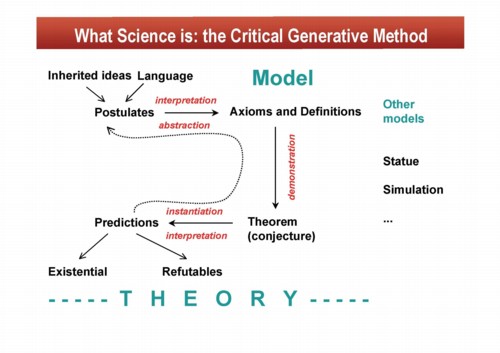
This conceptual framework is clearly an abstraction of what happens in reality. There is no single model, but several, either competing or complementary. The simultaneous presence of models representing a certain part of reality, together with computer simulations of the same reality, are daily evidence of this and provide us with the opportunity to understand just how far removed the model is from Reality. The plane's wing that is visible on the computer screen is clearly of a different nature from the real wing. However the former will allow construction of the latter after interaction with an imaginary atmosphere represented firstly by equations (Navier-Stokes' equations for instance) from the mathematical world of turbulence, and then by their digitisation according to an appropriate triangulation network. These equations are finally applied within a specific architecture made of Silicium, Germanium or Gallium arsenide, in which the rules of formal logics are represented (yet another model)... But when, because of a strong wind, the plane crashes, the model's inadequacy, and the need for reformulating it, become obvious. The processes described above now take place.
There are many other situations where several models of the same reality coexist, despite their apparent irreconcialibility. This is the case for example, when one considers magnetic phenomena at the microscopic level, of classical models (which are linked to dynamics) and quantum mechanical models (which have an algebraic construction). In the case of Nuclear Magnetic Resonance, for example, both models coexist, and the type of experiment depends on the model considered. One usually constructs spectrometers with the classical model in mind: the results are subsequently interpreted using the quantum-mechanical representation. The corresponding interpretations differ so widely that there is usually no conflict, but the mental representations of the phenomenon (and consequently, the way in which further exploration is considered) differ according to the chosen model.
The progress of knowledge
In the Generative Critical Method, as outlined above, one can easily see a process of evolution, a sort of branching-out, similar to phylogeny. Even preconceived ideas, and the civilisation which produces them are not fixed. We are thus facing not only a synchronic variety of civilisations and representations of Reality but also a diachronic variety, which is even richer as more time has passed. And, as the representation of Reality increases in precision, through the creation of models which are tested for their appropriateness (in a more efficient manner than they are tested for their diachronic stability), the issue of communication between models and, consequently, between civilisations becomes increasingly important: one will try, at least implicitly, to look for a minimal representation of reality which is universal. It follows that such temporal development is perceived not just as advancement but as progress, which adds an ethical dimension to knowledge production. I shall not deal with that dimension now - although it is of great interest - but I shall simply try to describe the formal consequences of such progress, and the orientation it gives to future models of our world.
If we consider that models are based on the world as it was represented to us by our predecessors within a given civilisation, the historical study of the evolution of models can give us insight into the way they were constructed and how they were developed over the course of time. It seems clear in this context - as the Greek philosophers who preceded Socrates, and in particular the atomists, pointed out - that the initial point of departure is stimulated by human nature and by its biological constraints. We are linked to our perception of the world in a very concrete way. Our senses provide us with an initial image, and it is our brain, inherited through biological evolution, that imposes on us our first a priori synthetic judgements. The first consequence of this situation is that an initial structure exists which underlies our models of the world. This scale is determined by what we perceive directly through our senses. Its dimension is therefore that of Man himself and it is subject to the constraints of the corresponding macroscopic vision. Consequently, the first models emphasise a global vision of what they represent, and the whole is considered as the only important aspect of the process of modelisation. But, and I shall not dwell on this, there is a certain degree of conceptual convergence between a holistic representation of things and the religious aspect of the three powers. The result is that theories are seen as fixed, thus precluding any analysis of phenomena. This original modelisation process is easily discernible in presocratic philosophy, where two holistic representations are in conflict, according to whether they emphasise permanence (Parmenides) or change (Heraclitus). They are resolved by the atomists (Leucippus and Democritus) who combine both aspects of reality, by changing the spatial scale - thus obliging philosophers to use analytical methods - and link together microscopic parmenidian worlds in a permanent state of flux, but with a deterministic evolution pattern, which produces the great variety of forms present in the world. Atomist thinking has long been overshadowed by holistic and religious philosophers, but after several centuries it was eventually recognised, breaking into pieces the whole, which then became amenable to analysis.
Astronomy, medicine and chemistry were thus placed, more or less at the same time, in an entirely new world, which could be explored through mediation: analysis, because of the change in scale it presupposes, alleviates the constraints of sensory perception. Perception of the world now becomes indirect. In parallel, instruments of investigation are developed which facilitate discovery of the content of the whole. This is a true conceptual revolution, which is still in its early stages today, and its consequences are still far from being understood. Indeed the question of substance, matter and form, is then entirely restructured. Genesis and function of borders take on new importance, as they become mediation areas for direct perception, macroscopic perception, and representation mediated through instruments and models, of a microscopic world supposed to be developing, as content, from within.
The very idea of content becomes questionable as atoms themselves are dissolved into more and more elusive entities, a process that can be likened to onions losing their peels. Thus our representation of the world is profoundly altered, progress being derived from analysis of the content of initially represented entities. One will easily understand, then - but I cannot examine this here -, that resistance meant to keep alive the old way of thinking, and to prevent, almost by principle, analytical methods, can be found everywhere. An intelligent form of such resistance is evident in the emphasis placed by the mathematician René Thom on the study of the most macroscopic forms of life, excluding everything that composes (and determines) them. But the most important consequence of this evolution in models is the production of new concepts, which, needless to say, change our philosophical representations as well as our metaphysical inquiries. Before illustrating this with biological concepts, I pointed out above that one should be very careful about using analogies, even if they are obviously very useful - which suggests that it would probably he inappropriate to discard, in the name of progress, other forms that are derived from previous concepts. As in the evolution of species, which is based on a branching-out, the evolution of models produces offsprings that are very different from their common ancestors. It is therefore quite possible that, in parallel with analytical models, descendants of holistic models could still have something interesting to say. It is in this sense that I appreciate the value of certain approaches proposed by René Thom.
Here is an example. Even if one has, quite correctly, chosen a microscopic (molecular) representation of life, some rules are still nevertheless applicable to the organism as a whole. One knows for instance that the building blocks of living things are dissymmetrical (this is the first great discovery made by Pasteur, who isolated left-handed levogyrous tartaric acid crystals from wine sediments). How then can we explain forms that exhibit mirror-symmetry forms in plants or animals? This is the case with a ram's horns, which are made of unsymmetrical proteins that fold symmetrically: if one represents the ram's forehead by a rectangle, the cells on the surface of the head are, in space, arranged in symmetrical fashion (on a macroscopic scale only, our normal euclidian space some are on the front, some in the centre, some behind, some on the edges...). The genetic programme needs then only specify the algorithmic command: "on the front and on an edge I multiply fast", to create a spiral growth. This demonstrates the interest of a macroscopic model of this particular process, which should not however exclude microscopic underlying models. In contrast, "systems theory", a still very fashionable approach in the West founded upon a verbalism that would be very interesting to study from the socio-cultural point of view, often (but fortunately not always) aims to take into account a holistic approach to represent natural phenomena, but, as Carolyn Merchant points out in a very interesting study of the role of women in the birth of ecological thinking in the West: "Systems theorists claim for themselves a holistic outlook, because they believe that they are taking into account the ways in which all the parts in a given system affect the whole. Yet the formalism of the calculus of probabilities excludes the possibility of mathematising the gestalt - that is, the ways in which each part of any given instant take their meaning from the whole. The more open, adaptive organic, and complex the system, the less successful the formalism. It is most successful when applied to closed. artificial precisely defined relatively simple systems." Thus, representing the whole requires, first, looking for relevant analytical levels, below which one will refuse to go for the considered representation. This entails looking for borders, defining contents and containers. This does not always lead to a solvable problem, as there are borders that are so intrusive that they occupy everything they contain. I shall not speak of that here (they are called fractals by Benoît Mandelbrot) but this could probably account in fact for present-day evolution of models in Western civilisations, where there is a strong trend toward the disappearing of contents.
But let us return to our reflections on progress. What is (historically) important, is the study of objects (one can see there part ot parmenidian constraints, linked to the permanence of things), then comes taxonomy. It is only afterwards that analysis appears, with its new capacities for exploration. It leads first, quite naturally, to identification of new objects (on a different scale), and of their taxonomic arrangement. Then, and this represents considerable progress, comes the discovery of the importance of relationships between these objects. By getting away from the constraint imposed by the whole, the analytical method opens a new universe, extremely abstract, and for this reason often ill-perceived or completely ignored, which is that of structures, of sets of symbolic "arrows" which link objects to each other. Thus a new form, devoid of content in the usual way - and therefore without classical borders - is born. We have here a true conceptual revolution, which often escapes our attention, and which can lead, when it develops in a given civilisation, to large differences when compared to what develops in other civilisations. This revolution reinforces the disappearance of the role of perception, as there is no longer any justification for looking at objects as such. Besides, because modelisation produces new concepts that can be used for the building up of new objects, important technological consequences will occur during development of the new models. Progress in the creation of knowledge therefore leads to progress in know-how and techniques, and, accordingly, to further discrepancy between the current status of civilisations. And it must be stressed that this is not a minor point because newly created objects are true elaborations, inventions rather than discoveries, purely human artefacts, and, as such, the very landmarks of the civilisations which have produced them. A laser beam is a striking example of this because it exists in the universe only as an artefact.
We can see here two very different aspects of theoretical processes within Western civilisations. On the one hand, the existence of an original method, founded on the intimate perception (and conceptualisation) of the modesty of Man in the universe, and on the positive aspects of the systematic exploitation of errors, rather than of successes, and, on the other hand, the displacement of the idea of content towards the study of forms, conceived as relationships between objects. I have briefly indicated the generative function of the first aspect. I shall now illustrate the second in the recent - and revolutionary - development of life sciences in Western civilisations.
The Delphic boat (Theseus's ship)
What has just been said is still very abstract. It would be easy to illustrate it with examples from physics or astronomy or, better perhaps, from this new science called data mining. But it seems to me that biology, particularly in its most recent form, displays both the need for a critical approach and the role played by civilisation in constructing models.
One has, naturally, a tendency to consider objects first. And biology has not escaped this tendency (which is perhaps always necessary in the initial exploratory phase that precedes the birth of a science). Biology however - discovered less than half a century ago, but already used by Cuvier when he reconstructed a whole organism from a jawbone, or even a tooth - is not so much a science of objects than a science of relationships between objects (and often even of relationships between relationships). Objects created by living beings have a series of specific traits that make them immediately recognisable: technique provides us with numerous examples, and the Greeks observed what was original in such objects. If one considers for example a boat, made by adjusting wooden planks, the question arises as to what constitutes the boat. Indeed as time passes planks become worn or start to rot, in such a way that they must be replaced. Eventually, one ends up with a boat which is similar to the original but made of entirely new planks: is it the same boat? Our knowledge in physiology shows that the same holds for a living being during its life span: is it the same being? Where is its identity located? And, moreover, is it not possible to predict the boat's general form and function from a fragment of this same boat?
It is by studying the nature of what constitutes life's permanence that one understands that it is of an abstract nature, and that one should analyse underlying relationships rather than base oneself on the whole organism. To this we must add the dynamics of life. The time dimension will add further relationships which must be taken into account if one wishes to produce accurate models of the living What has just been said does not entirely exclude objects or their physico-chemical nature: one only has to replace the wooden planks of the boat at Delphi by iron panels to understand this. The organism will therefore also depend on the nature of the physical objects that constitute it.
Life can be understood as follows. There are four main processes. The first, metabolism, is the ability to chemically transform the environment: living entities extract some chemicals and create different ones. The second process, which is essential, is compartmentalisation: there is no living being without a membrane or a skin. Two new processes follow. On the one hand the ability to transmit "something" from generation to generation, which we can call memory, the chemical substrate of which is the family of so-called nucleic acids. Last but not least, the ability to manipulate the environment through a specific transposition of the memory into proteins, via the exquisitely tuned and specific catalytic processes they can trigger and perpetuate. Contrary to expectation, the number of objects that contribute to these four processes is very small. Metabolism, for instance, in an entirely autonomous cell, comprises about five hundred types of more or less related molecules, no more. Nucleic acids are made up of the chaining of only four or five types of chemically similar molecules. In order to form a functional nucleic acid, these building blocks are chained like alphabetic letters in a written sentence. The same is true for proteins, but this time 20 amino-acid residues are enough to form all of them. We have here an initial representation of macromolecules, as they are called, in the form of a text like Western writing. The corresponding model of life, extremely rich in its conceptual and practical consequences, is therefore historically linked to the place of its creation: is it possible to think that it could have been invented elsewhere in the world, for instance, where alphabetic writing does not exist? Nothing seems less likely. This uncovers a new constraint in our modelisation of reality. Customs specific to a given civilisation may be particularly appropriate as a representation of a fragment of reality. This is purely contingent, and not at all a formal reason for the success of corresponding models. Thus the presence of a cultural trait has important consequences. (It should be stressed here that what I see as a contingent cause has been described in several philosophical traditions as the signature of an underlying general principle of identity, as in platonism for instance). It seems to me, accordingly, of major importance to take note of this observation. If there had been only one uniform civilisation on the earth, with a unique mode of writing, for example using ideograms, it seems likely that, for a long time (with the exception of the possible influence of arithmeticians, who often manipulate integers like an alphabet), many aspects of genetics would have been totally inaccessible. When faced with an unpredictable future, it is the diversity of answers which affords a solution. We should therefore react against the uniformisation of civilisations, in the name of scientific progress.
It is possible to go a little further, and to show how the linguistic metaphor has fundamental consequences in our representation of reality. I have spoken of memory and of function, that is of nucleic acids which play the role of memory transmitted down through the generations, and of proteins whose role is to execute or act out. It is natural to investigate the reasons for this separation into two functions, and its operative role. Cech discovered in 1981 that some RNA molecules could display both activities, i.e. could both reproduce themselves and exhibit catalytic activity. This solves in part the chicken and egg paradox: which comes first, protein or nucleic acid? RNAs are first, as they carry out both memory and manipulation functions. However, of course, one needs to discover how their building blocks, the nucleotides, are made, but let us for now forget about this fundamental question. Once one recognises that RNAs were invented the sequence of evolution can be easily understood. Now, this sequence is of crucial importance, because it will replace one object which has two specificities (memory and function), with two objects which allow memory and function to be separated. It is from this separation that the coding process which is central to life is derived. For it is this very unusual property which allows memory to be transposed into function which is essential to life. Once again, it should be emphasised that this is a very special relationship, very abstract, and therefore extremely difficult to understand: separating memory from function facilitates action, through function, on the memory template (which itself specifies function). As a result, a loop, a self-referring process, is created, which allows a structure and a dynamic recursive processes that are of an entirely new type to exist, without any need for an external principle such as a soul, a spirit or a mind.
The philosophical consequences of this situation are multifold, and have yet to be explored. In addition, they render all former representations obsolete, because no one had thought of nature producing an organisation of this type. In this sense the present day study of biology is revolutionary, and shakes the foundations of the very civilisations that have produced the corresponding knowledge. The fact that the alphabetic metaphor is at the base of all this means that if certain civilisations do not want to be excluded from this evolution which is based on new models, then they must conform to this mode of communication. But this also reinforces the fundamental contingency of discovery, of the need for modesty, and of the necessity to maintain other ways of thinking (if not other methods) so that once we have set sail for India, we are still capable of discovering America.
Bibliography
Bernard (C.) Introduction à l'Etude de la médecine expérimentale,
1865, 16ed. Flammarion, Paris, 1952.
Danchin (A.) L'invasion du biologisme, Le Débat, 2, 66-81, 1980.
Danchin (A.) Comment peut-on parler de l'automate cérébral aujourd'hui
Revue Philosophique, 3, 287-304, 1980.
Danchin (A.) Une aurore de pierres, Le Seuil, Paris, 1990.
Diels (H.) Die Fragmente der Vorsokratiker, Weidmannsche Buchhandlung,
Berlin, 1901.
Dumézil (G.) Mythe et Epopée, Gallimard, Paris, 1973.
Kuhn (T. S.) The Structure of Scientific Revolutions, University of
Chicago Press, Chicago, 1962.
Moreau de Maupertuis (P.L.) Vénus physique, 1754, 16ed. Aubier, Paris,
1987.
Merchant (C.) The Death of Nature : Women, Ecology and the Scientific
Revolution, Harper and Row, 1983.
Thom (R.) Apologie du logos, Hachette, Paris, 1990.
