
Do
protein agents « animate » biological chemistry?
ANTOINE DANCHIN
唐善 • 安東
Why
is human longevity unusually long?
Origins of life and common
sense: how could arsenic replace
phosphorus?
Paralogous
metabolism
Building up
a synthetic genome does not mean understanding what it codes for,
or does it?
The evolution of the COVID-19
pandemic
We perceive the world through four categories of objective being: space, time, mass and energy. To this list, physics adds information as an essential component. The involvement of information resolves the conflicts between classical and quantum physics. From a heuristic point of view alone, information is a genuine category of reality. Accumulation of information is the consequence of a concrete substantiation, an incarnation into matter endowed with mass of those agents that James Clerk Maxwell invented in 1871, known today as « Maxwell's demons ».
Here, we develop the consequences of the principle
discovered by Rolf Landauer in 1961, and which has taken decades to
understand. Reflecting on what common sense calls information - with
the connotation of what might be « useful » information, or
information with contextual value - Landauer demonstrated that the
creation of information, contrary to popular belief, is reversible, it
does not dissipate energy. 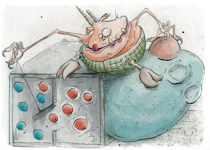 What
does consume energy is the process of resetting the agents that
generate information to their ground state, enabling them to perform
their function once again. If we think of living organisms as analog
(rather than digital) computers capable of generating computers
we need to include the presence of agents that drive and control the
assembly line of the machine's offspring. These energy-dissipating
agents are absent from the standard vision of computing. If we then
explore the functions of the cell that seem to dissipate energy for no
apparent reason, analysis of the genome sequence reveals numerous
genes that code for these functions. This discovery sheds light on the
heart of what makes biological chemistry seem 'animate', a feature of
life that has always remained elusive.
What
does consume energy is the process of resetting the agents that
generate information to their ground state, enabling them to perform
their function once again. If we think of living organisms as analog
(rather than digital) computers capable of generating computers
we need to include the presence of agents that drive and control the
assembly line of the machine's offspring. These energy-dissipating
agents are absent from the standard vision of computing. If we then
explore the functions of the cell that seem to dissipate energy for no
apparent reason, analysis of the genome sequence reveals numerous
genes that code for these functions. This discovery sheds light on the
heart of what makes biological chemistry seem 'animate', a feature of
life that has always remained elusive.
+ Caveat : The epilogue to The Delphic Boat. Harvard University Press, 2003. Scientists should have no name...
Dealing with information,
this site is information-rich;
To get a flavour of its content : Draw a page
at random
An article in english, drawn at random
This site is multilingual. To read all characters,
set your browser to charset utf-8
The layout will follow new CSS rules. Recent browsers should be
preferred
Sometimes the disappearance is politically
motivated. In this case, this site seeks to collect the original and
puts it online