|
|
|
|
|
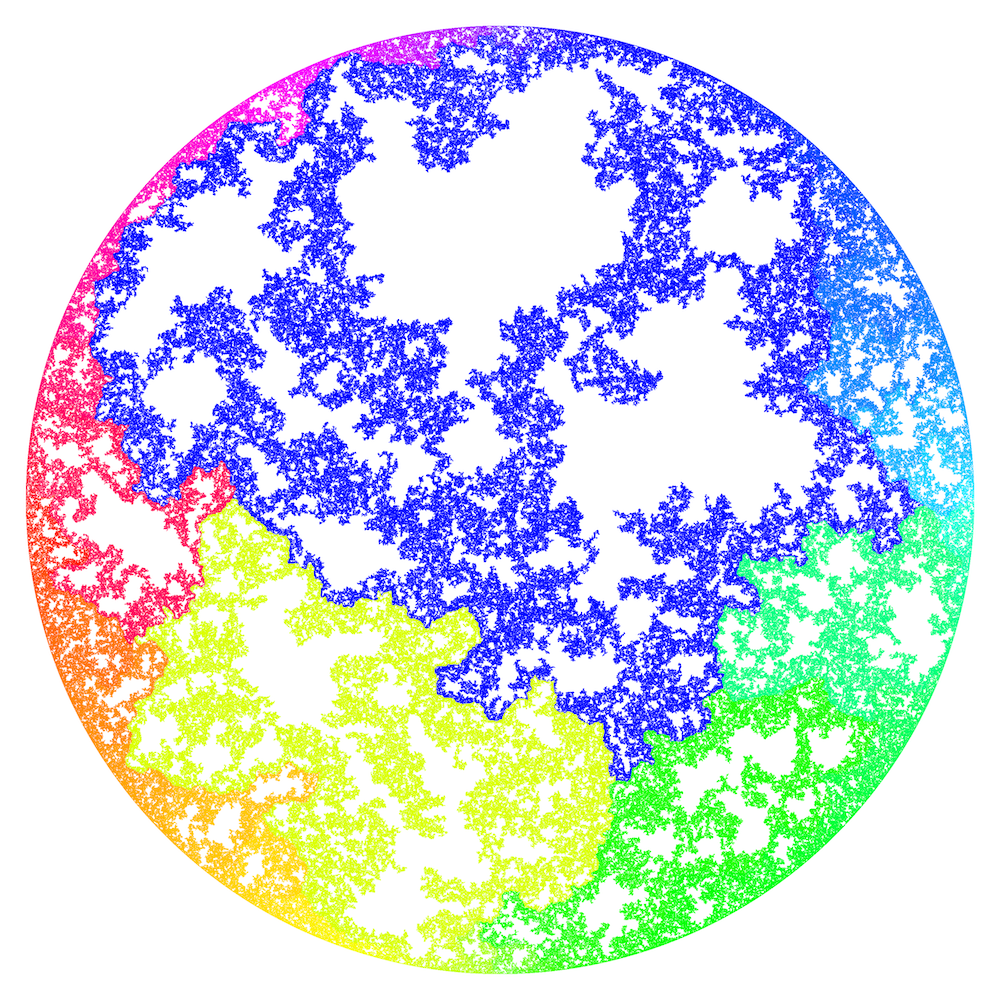
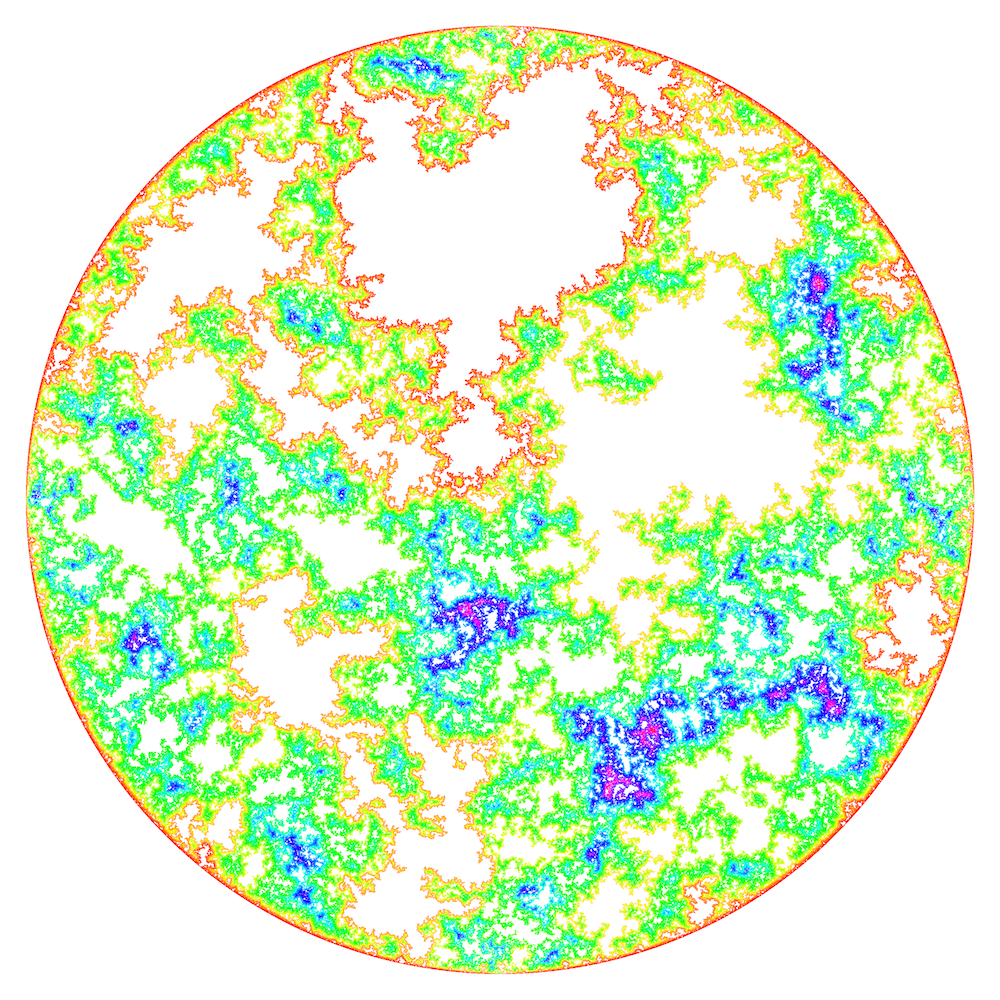
| Abstract: This paper is the third and final article in a series of papers constructing the canonical conformally invariant metric on the set of loops of the conformal loop ensemble (CLE) with critical parameter \(\kappa=4\). The previous two articles construct, as a subsequential limit of the renormalized graph metric on the loops of CLE\(_4\) as \(\kappa \downarrow 4\), a conformally invariant, local metric on the loops of a CLE\(_4\) whose metric ball growth from the domain boundary coincides with the uniform exploration of Werner and Wu. In this paper, we establish that this metric is uniquely characterized by its properties, as are its geodesics, and that it is a measurable function of the CLE\(_4\). In particular, we show that the renormalized CLE\(_\kappa\) graph metric converges as \(\kappa\downarrow 4\) without passing to a subsequence. A key step in the proof is to show that the metric is determined by the geodesics from each loop to the domain boundary, which are in turn determined by the uniform exploration; this representation will have important applications in future work. | ![]() |
![]() |
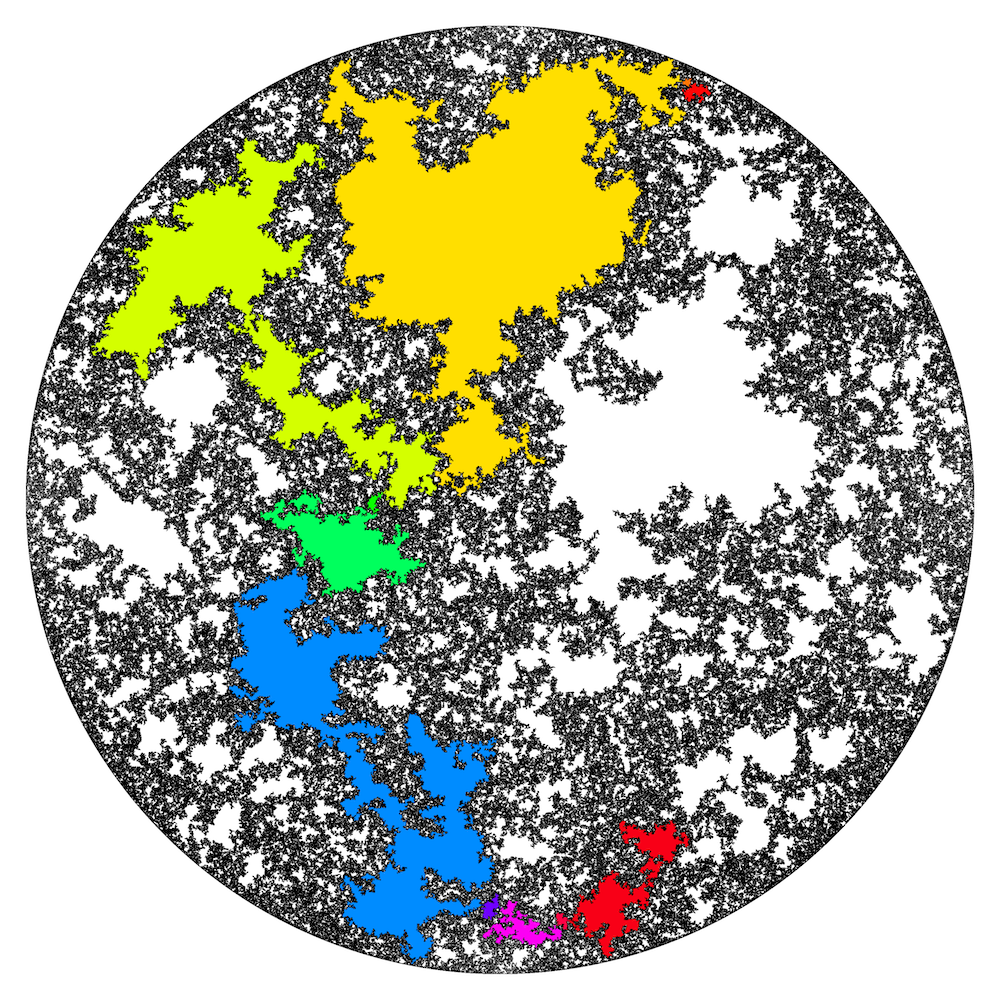
| Abstract: We continue our study of the conformal loop ensemble (CLE) with parameter \(\kappa=4\), the critical threshold at or below which the loops are simple and disjoint, touching neither each other nor the domain boundary. This paper is the second in a series of three establishing that the loops of a CLE\(_4\) uniquely determine a conformally invariant, local, and geodesic metric such that the metric ball growth from the domain boundary coincides with the uniform exploration of Werner and Wu. In this second paper, we prove the existence of geodesics, showing that any geodesic between two loops is supported on the CLE\(_4\) loops (off a set of Hausdorff dimension zero) and does not intersect the domain boundary. Along the way, we establish sharp quantitative estimates for the CLE\(_4\) metric geometry, including exponential tail bounds for rectangle distances and multi-scale four-arm SLE\(_4\) non-intersection bounds for metric balls. | ![]() |
![]() |
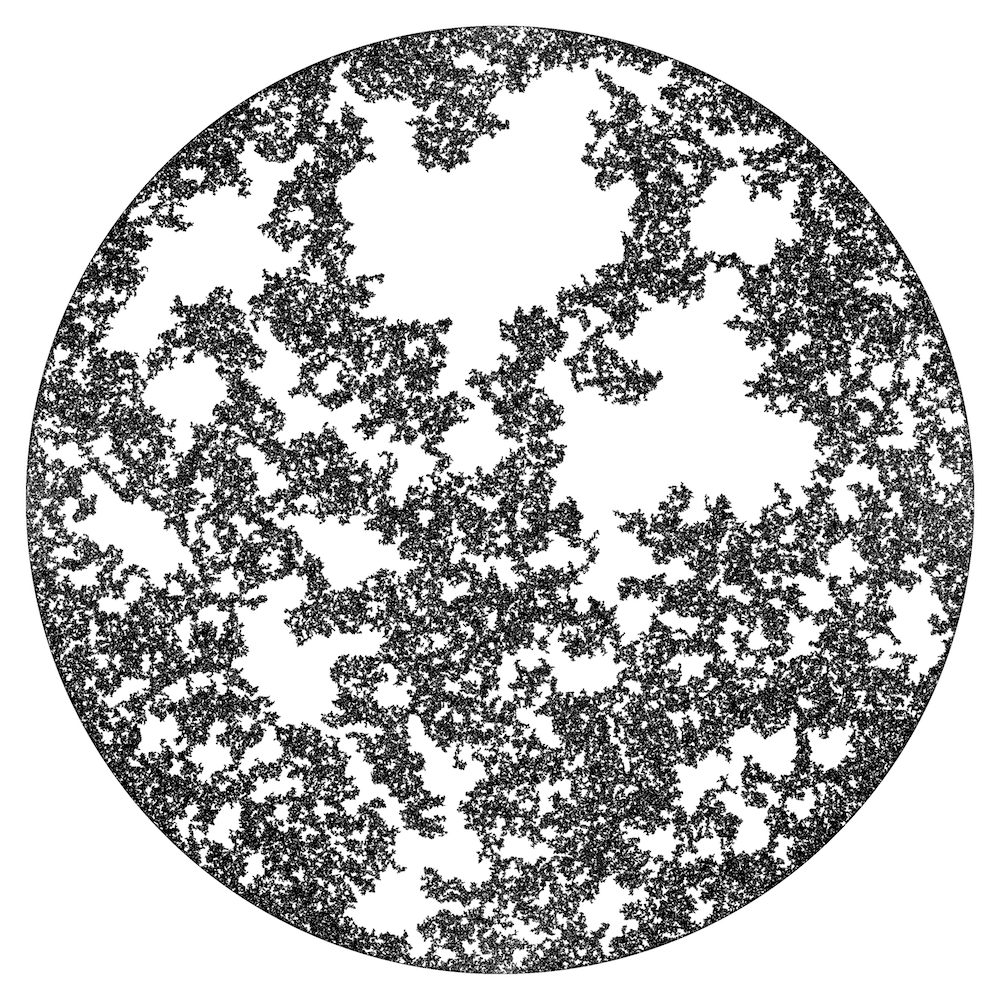
| Abstract: We consider the conformal loop ensemble (CLE) with the parameter \(\kappa=4\), the critical value at or below which the loops are simple and do not intersect each other or the domain boundary. We show that the loops of a CLE\(_4\) uniquely determine a conformally invariant, local, and geodesic metric so that the metric ball growth from the domain boundary coincides with the uniform exploration of Werner and Wu. This metric was previously constructed in unpublished work of Sheffield, Watson, and Wu. Our approach differs in that we show that the metric arises as the renormalized limit of the graph metric on CLE\(_\kappa\) loops as \(\kappa \downarrow 4\). In this first paper in a series of three, we prove that the subsequential limits exist and define a non-trivial conformally invariant metric on CLE\(_4\) which is local and such that the metric ball growth from the boundary is given by the uniform exploration of Werner and Wu. In subsequent work, we will show that the subsequential limit exists as a true limit. | ![]() |
![]() |
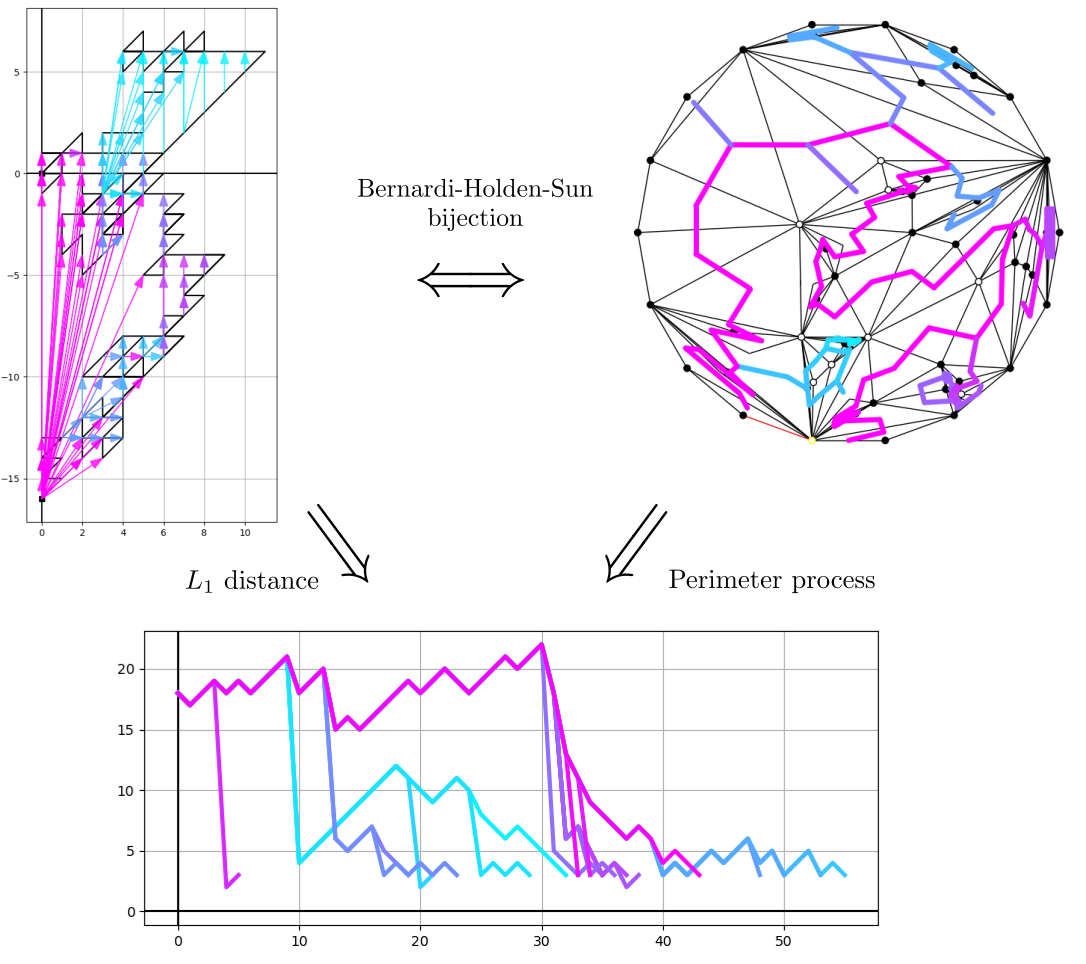
| Abstract: In this note, using a bijection of Bernardi, Holden and Sun, we give an explicit geometric relation between the perimeter of the peeling process along the percolation interface of a triangulation, and the corresponding Kreweras walk. The relation naturally extends to the branching peeling exploration. This sheds light on the relation between the growth-fragmentation process and correlated Brownian excursions discovered by Da Silva, Powell and Watson. | ![]() |
| Abstract: We study the depth-weighted random recursive trees introduced by Leckey, Mitsche and Wormald in the case where the weights are bounded from above and from below. We establish the scaling limit of the depth profile of these trees when the weights satisfy a law of large numbers. In particular, we obtain the scaling limit of the depth of these trees, generalising some results of Lichev, Linker, Lodewijks and Mitsche. We also answer negatively a question left open by the same authors, showing that the scaling limit of the depth does not hold in general. Our main tools are appropriately defined martingales combined with the general Edgeworth expansion for the profiles introduced by Kabluchko, Marynych and Sulzbach. |
| Abstract: We are interested in the geometry of the "infection tree" in a stochastic SIR (Susceptible-Infectious-Recovered) model, starting with a single infectious individual. This tree is constructed by drawing an edge between two individuals when one infects the other. We focus on the regime where the infectious period before recovery follows an exponential distribution with rate \(1\), and infections occur at a rate \(\lambda_n \sim \frac{\lambda}{n}\) where \(n\) is the initial number of healthy individuals with \(\lambda>1\). We show that provided that the infection does not quickly die out, the height of the infection tree is asymptotically \(\kappa(\lambda) \log n \) as \(n \to \infty \), where \(\kappa(\lambda)\) is a continuous function in \(\lambda\) that undergoes a second-order phase transition at \(\lambda_c \simeq 1.8038\). Our main tools include a connection with the model of uniform attachment trees with freezing and the application of martingale techniques to control profiles of random trees. | ![]() |
![]() |
| Abstract: We establish the scaling limit of the geodesics to the root for the first passage percolation distance on random planar maps. We first describe the scaling limit of the number of faces along the geodesics. This result enables to compare the metric balls for the first passage percolation and the dual graph distance. It also enables to upperbound the diameter of large random maps. Then, we describe the scaling limit of the tree of first passage percolation geodesics to the root via a stochastic coalescing flow of pure jump diffusions. This stochastic flow also enables us to construct some random metric spaces which we conjecture to be the scaling limit of random planar maps with high degrees. The main tool in this work is a time-reversal of the uniform peeling exploration. |
|
| Abstract: We prove that for \(n=2\) the gaskets of critical rigid \(O(n)\) loop-decorated random planar maps are \(3/2\)-stable maps. The case \(n=2\) thus corresponds to the critical case in random planar maps. The proof relies on the Wiener-Hopf factorisation for random walks. Our techniques also provide a characterisation of weight sequences of critical \(O(2)\) loop-decorated maps. |
|
| Abstract: We consider large uniform random trees where we fix for each vertex its degree and height. We prove, under natural conditions of convergence for the profile, that those trees properly renormalized converge. To this end, we study the paths from random vertices to the root using coalescent processes. As an application, we obtain scaling limits of Bienaymé-Galton-Watson trees in varying environment. |
|
| Abstract: The purpose of this article is threefold. First, we show that when one explores a conformal loop ensemble of parameter \( \kappa=4\) (\( \mathrm{CLE}_4 \)) on an independent \(2\)-Liouville quantum gravity (\(2\)-LQG) disk, the surfaces which are cut out are independent quantum disks. To achieve this, we rely on approximations of the explorations of a \(\mathrm{CLE}_4\): we first approximate the \( \mathrm{SLE}^{\langle\mu \rangle }_4(-2) \) explorations for \(\mu \in \mathbb{R}\) using explorations of the \(\mathrm{CLE}_\kappa\) as \(\kappa \uparrow 4 \) and then we approximate the uniform exploration by letting \(\mu \to \infty\). Second, we describe the relation between the so-called natural quantum distance and the conformally invariant distance to the boundary introduced by Werner and Wu. Third, we establish the scaling limit of the distances from the boundary to the large faces of \(3/2\)-stable maps and relate the limit to the \(\mathrm{CLE}_4\)-decorated \(2\)-LQG. |
|
| Abstract: We investigate scaling limits of trees built by uniform attachment with freezing, which is a variant of the classical model of random recursive trees introduced in a companion paper. Here vertices are allowed to freeze, and arriving vertices cannot be attached to already frozen ones. We identify a phase transition when the number of non-frozen vertices roughly evolves as the total number of vertices to a given power. In particular, we observe a critical regime where the scaling limit is a random compact real tree, closely related to a time non-homogenous Kingman coalescent process identified by Aldous. Interestingly, in this critical regime, a condensation phenomenon can occur. |
|
| Abstract: In the classical model of random recursive trees, trees are recursively built by attaching new vertices to old ones. What happens if vertices are allowed to freeze, in the sense that new vertices cannot be attached to already frozen ones? We are interested in the impact of freezing on the height of such trees. | ![]() |
| Abstract: We discuss asymptotics of large Boltzmann random planar maps such that every vertex of degree \(k\) has weight of order \(k^{−2}\). Infinite maps of that kind were studied by Budd, Curien and Marzouk. These maps can be seen as the dual of the discrete \(\alpha\)-stable maps studied by Le Gall and Miermont for \(\alpha=3/2\) or as the gaskets of critical \(O(2)\)-decorated random planar maps. We compute the asymptotics of the graph distance and of the first passage percolation distance between two uniform vertices, which are respectively equivalent in probability to \((\log \ell)^2/\pi^2\) and \(2(\log \ell)/(\pi^2p_{\bf q})\) when the perimeter of the map \(\ell\) goes to \(\infty\), where \(p_{\bf q}\) is a constant which depends on the model. We also show that the diameter is of the same order as those distances for both metrics and obtain in particular that these maps do not satisfy scaling limits in the sense of Gromov-Prokhorov or Gromov-Hausdorff for lack of tightness. To study the peeling exploration of these maps, we prove local limit and scaling limit theorems for a class of random walks with heavy tails conditioned to remain positive until they die at \(-\ell\) towards processes that we call stable Lévy processes conditioned to stay positive until they jump and die at \(−1\). | ![]() |