Topology and nonlinear parametric oscillators
Parametric oscillators consists in large subharmonic resonance of a pendulum driven externally by an oscillating field. Due to subharmonic response, the phase of the pendulum's oscillation can take two specific values separated by half a period, and the choice of one or the other phase depends on initial conditions. In a recent work, we have explored how a to switch from one phase state to the other using an external perturbation. A general theoretical framework is developped both in the linear and non-linear case, and a topological interpretation of the transition is discussed. We also conduct experiments using Faraday instability at the water surface.

Frustration and computing in a chain of parametric oscillators
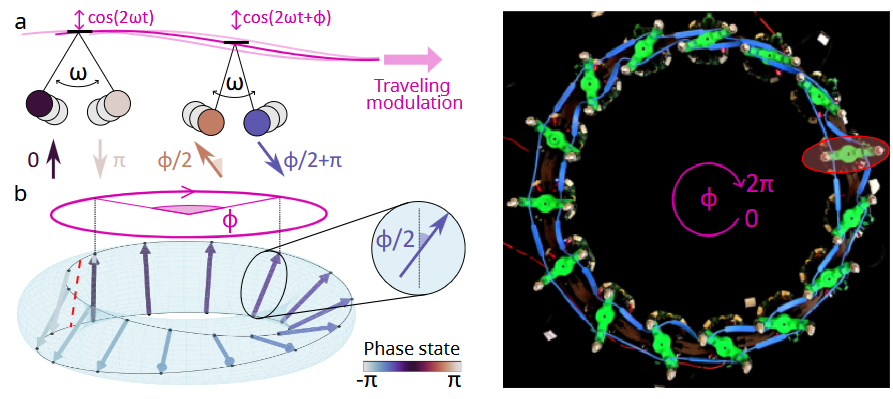
Building on this idea to play with the two phase states, we then considered a chain of coupled parametric oscillators excited by a propagating wave. This results in each oscillator exhibiting two limit cycles with its own phases that depend on the local excitation, while coupling between neighbours induces correlations: neighboring oscillators tend to oscillate in phase. In a recent work, we considered a closed chain excited by a wave which wavelength is the length of the chain. The excitation phase experienced by the oscillators winds from 0 to 2PI along the circle, while response phase half-winds from 0 to PI due to subharmonic response. Hence, two oscillators must be out of phase somewhere! Interestingly, this phase kink moves along the chain in a regular, soliton-like manner that we characterized theoretically with the help of O. Gamayun (LIMS), and experimentally with a chain of active pendulums built in Corentin Coulais's lab (UvA). On top of that, we also manipulated such soliton in several ways: it can be split, stopped, combined with another one... and leveraged this flexibility to create mechanical computers !
Publications :