COSQUA
Cosmology and Quantum Simulations
Context
In quantum field theory, particles are identified with excitations of fields. Even in a vacuum, fields are subject to quantum fluctuations, which can be amplified to create particles. This phenomenon plays a crucial role in astrophysics and cosmology and is known as spontaneous particle production, to distinguish it from its stimulated counterpart seeded by classical fluctuations. It is the underlying mechanism behind black hole evaporation via Hawking radiation [1], the generation of primordial cosmological inhomogeneities during inflation [2], and the generation of particles in an empty post-inflationary universe, a phenomenon known as preheating [3]. However, a direct observation of these phenomena in the cosmological context is currently out of reach [4,5].
Beginning in 1981 [4], a field of study has developed in which fluids host analogs of the above phenomena. Unruh showed that, in the presence of a strong coherent background, the excitations of a fluid, or quasiparticles, can be treated using the same formalism as particles in a curved spacetime.
Project
In this project, we propose to use a Bose-Einstein Condensate to observe spontaneous amplification of quasiparticles. Because of the non-zero temperature of the gas, both thermal and vacuum fluctuations seed the amplification process [6]. The role of vacuum fluctuation in seeding the growth can then be revealed by witnessing entanglement between opposite momentum quasiparticles [5]. As the number of created quasiparticle become too large, entanglement should disappear and the system will relax towards thermal equilibrium [7].

Results
-
Defense and publication of my PhD thesis
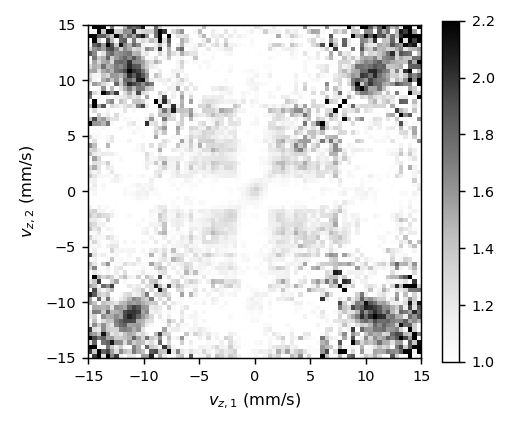
We discuss the recent defense and publication of my PhD thesis work entitled "On the entanglement of quasi-particles in a Bose-Einstein Condensate - from Faraday waves to the Dynamical Casimir Effect".
-
Probing entanglement of two-mode bosonic Gaussian states
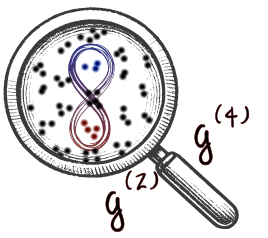
In this theoretical work, we show how to quantify entanglement of some two-mode bosonic Gaussian states relying on their full probability distribution i.e. by only counting particles.
-
Growth dynamics of Faraday waves
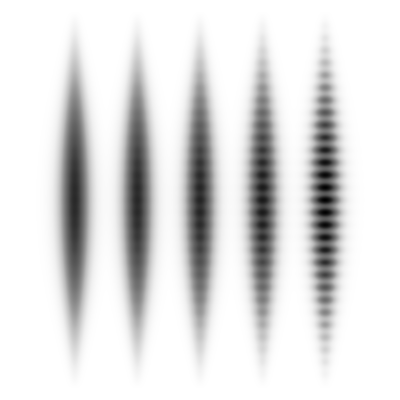
We shake an elongated Bose-Einstein condensate and studied the appearance of pattern i.e. collective excitation. We compare the growth of the pattern to analytical model and find a remarkable agreement.
-
Observation of Entanglement in an analog cosmological preheating
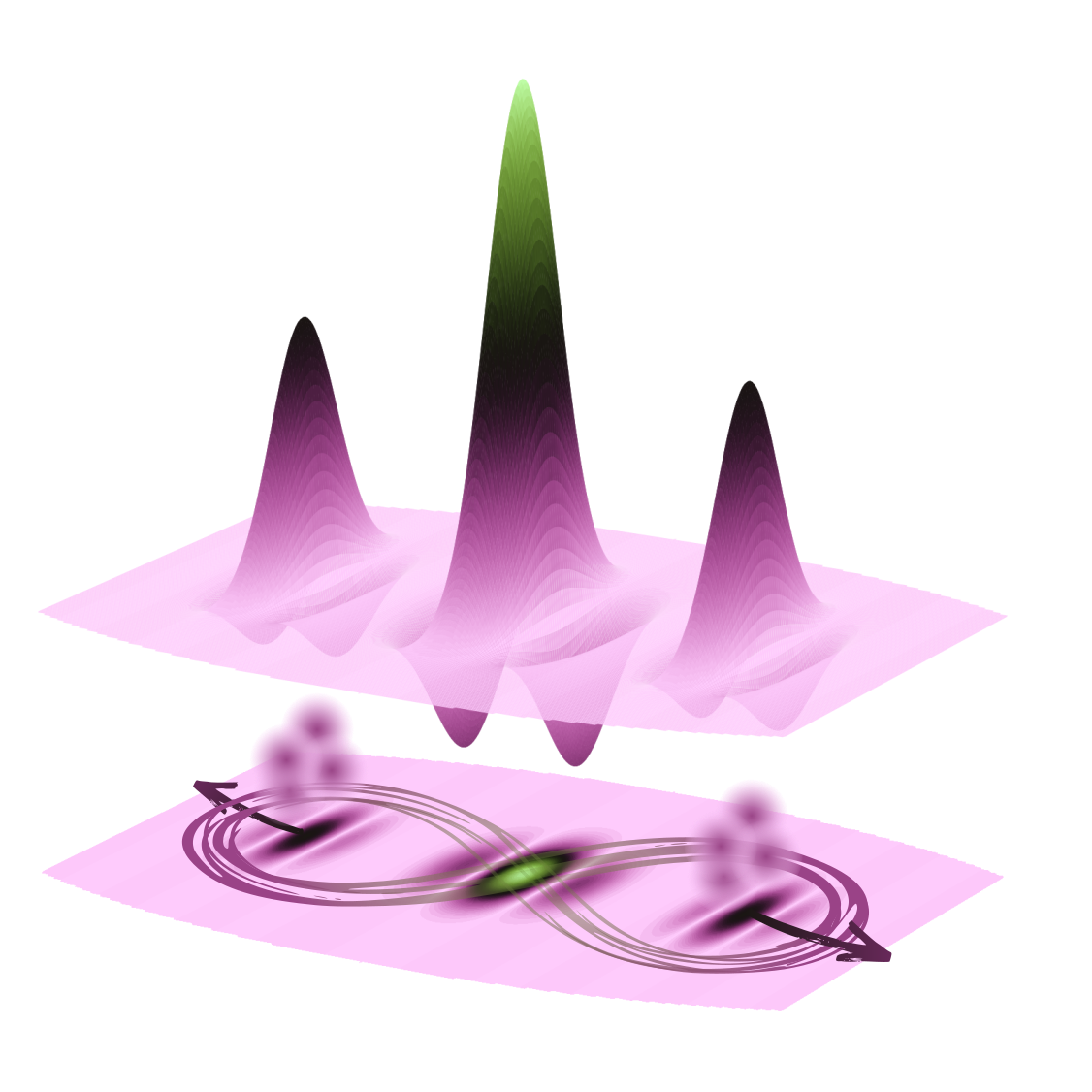
We observed entanglement between collective excitations in a parametrically excited Bose-Einstein condensate in a configuration analogous to particle creation in cosmological preheating. This observation paves the way towards the experimentally driven study of the late time dynamics in further analogy with cosmological reheating.
Bibliography
[1] S. W. Hawking, Black hole explosions?, Nature 248, 30 (1974).
[2] V. F. Mukhanov and G. V. Chibisov, Quantum fluctuations and a nonsingular universe, ZhETF Pisma Redaktsiiu 33, 549 (1981).
[3] L. Kofman, A. Linde, and A. A. Starobinsky, Towards the theory of reheating after inflation, Phys. Rev. D 56, 3258 (1997).
[4] W. G. Unruh, Experimental black-hole evaporation?, Phys. Rev. Lett. 46, 1351 (1981).
[5] D. Campo and R. Parentani, Inflationary spectra and violations of Bell inequalities, Phys. Rev. D 74, 025001 (2006).
[6] S. Robertson, F. Michel, and R. Parentani, Controlling and observing nonseparability of phonons created in time-dependent 1D atomic Bose condensates, Phys. Rev. D 95, 065020 (2017).
[7] S. Robertson, F. Michel, and R. Parentani, Nonlinearities induced by parametric resonance in effectively 1D atomic Bose condensates, Phys. Rev. D 98, 056003 (2018).